
|
You entered: space observations
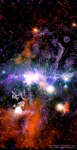 The Galactic Center in Stars, Gas, and Magnetism
2.06.2021
What's going on near the center of our galaxy? To help find out, a newly detailed panorama has been composed that explores regions just above and below the galactic plane in radio and X-ray light.
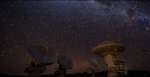 An ALMA Telescope Array Time Lapse
26.05.2014
It is the most expensive and complex ground-based astronomy project ever -- what will it see tonight? The Atacama Large Millimeter Array (ALMA) project consists of 66 dishes, many the size of a small house, situated in the high altitude Atacama Desert in Northern Chile.
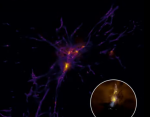 Simulation: Formation of the First Stars
30.06.2021
How did the first stars form? To help find out, the SPHINX computer simulation of star formation in the very early universe was created, some results of which are shown in the featured video. Time since the Big Bang is shown in millions of years on the upper left.
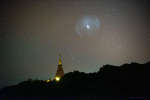 Comet Leonard behind JWST Launch Plume
27.12.2021
Which one of these two streaks is a comet? Although they both have comet-like features, the lower streak is the only real comet. This lower streak shows the coma and tail of Comet Leonard...
 APOD: 2024 February 18 Б Hoags Object: A Nearly Perfect Ring Galaxy
18.02.2024
Is this one galaxy or two? This question came to light in 1950 when astronomer Arthur Hoag chanced upon this unusual extragalactic object. On the outside is a ring dominated by bright blue stars, while near the center lies a ball of much redder stars that are likely much older.
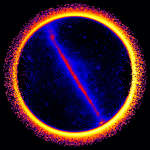 Gamma Ray Earth and Sky
6.12.2013
For an Earth-orbiting gamma-ray telescope, Earth is actually the brightest source of gamma-rays, the most energetic form of light. Gamma-rays from Earth are produced when high energy particles, cosmic rays from space, crash into the atmosphere.
 APOD: 2025 February 19 Б HH 30: A Star System with Planets Now Forming
19.02.2025
How do stars and planets form? New clues have been found in the protoplanetary system Herbig-Haro 30 by the James Webb Space Telescope in concert with Hubble and the Earth-bound ALMA. The observations show, among other things, that large dust grains are more concentrated into a central disk where they can form planets.
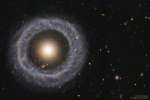 Hoags Object: A Nearly Perfect Ring Galaxy
27.11.2019
Is this one galaxy or two? This question came to light in 1950 when astronomer Arthur Hoag chanced upon this unusual extragalactic object. On the outside is a ring dominated by bright blue stars, while near the center lies a ball of much redder stars that are likely much older.
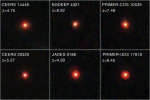 APOD: 2025 December 24 Б Mystery: Little Red Dots in the Early Universe
24.12.2025
What are these little red dots (LRDs)? Nobody knows. Discovered only last year, hundreds of LRDs have now been found by the James Webb Space Telescope in the early universe. Although extremely faint, LRDs are now frequently identified in deep observations made for other purposes.
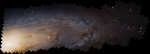 100 Million Stars in the Andromeda Galaxy
5.01.2015
What stars compose the Andromeda galaxy? To better understand, a group of researchers studied the nearby spiral by composing the largest image ever taken with the Hubble Space Telescope. The result, called the Panchromatic...
|
January February March April May June July August September October |
|||||||||||||||||||||||||||||||||||||||||||||||||