
|
You entered: universe
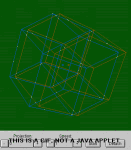 A Higher Dimensional Universe
18.03.2007
Does our universe have higher but unusual spatial dimensions? This idea has been gaining popularity to help explain why vastly separated parts of our universe appear so similar, and why the geometry of our universe does not seem to result naturally from the amounts of matter it seems to contain.
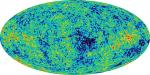 WMAP Resolves the Universe
11.07.2004
Analyses of a new high-resolution map of microwave light emitted only 380,000 years after the Big Bang appear to define our universe more precisely than ever before. The eagerly awaited results announced last year from the orbiting Wilkinson Microwave Anisotropy Probe resolve several long-standing disagreements in cosmology rooted in less precise data.
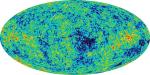 WMAP Resolves the Universe
25.09.2005
Analyses of a new high-resolution map of microwave light emitted only 380,000 years after the Big Bang appear to define our universe more precisely than ever before. The eagerly awaited results announced last year from the orbiting Wilkinson Microwave Anisotropy Probe resolve several long-standing disagreements in cosmology rooted in less precise data.
 Edwin Hubble Discovers the Universe
6.10.2023
How big is our universe? This question, among others, was debated by two leading astronomers in 1920 in what has since become known as astronomy's Great Debate. Many astronomers then believed that our Milky Way Galaxy was the entire universe. Many others, though, believed that our galaxy was just one of many.
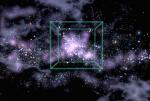 Unexpected Galaxy String in the Early Universe
20.01.2004
How could such a long string of galaxies form so early in the universe? Several new measurements of galaxies and clusters in the early universe are reporting structures involving galaxies and clusters that are larger than expected with the new standard "dark-energy" cosmology.
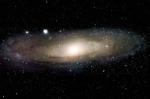 Andromeda Island Universe
18.05.2002
How far can you see? The most distant object easily visible to the unaided eye is M31, the great Andromeda Galaxy some two million light-years away. Without a telescope, even this immense spiral galaxy appears as an unremarkable, faint, nebulous cloud in the constellation Andromeda.
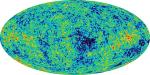 WMAP Resolves the Universe
12.02.2003
Analyses of a new high-resolution map of microwave light emitted only 380,000 years after the Big Bang appear to define our universe more precisely than ever before. The eagerly awaited results from the orbiting Wilkinson Microwave Anisotropy Probe resolve several long-standing disagreements in cosmology rooted in less precise data.
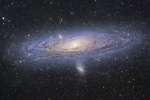 Andromeda Island Universe
24.01.2008
The most distant object easily visible to the unaided eye is M31, the great Andromeda Galaxy some two and a half million light-years away. But without a telescope, even this immense spiral galaxy - spanning over 200,000 light years - appears as a faint, nebulous cloud in the constellation Andromeda.
 A Flight Through the Universe
13.08.2012
What would it be like to fly through the universe? Possibly the best simulated video of this yet has been composed from recently-released galaxy data from the Sloan Digital Sky Survey. Every spot in the above video is a galaxy containing billions of stars.
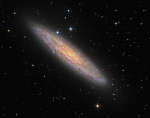 NGC 253: Dusty Island Universe
3.11.2016
Shiny NGC 253 is one of the brightest spiral galaxies visible, and also one of the dustiest. Some call it the Silver Dollar Galaxy for its appearance in small telescopes, or just the Sculptor Galaxy for its location within the boundaries of the southern constellation Sculptor.
|
January February March April May June July |
|||||||||||||||||||||||||||||||||||||||||||||||||