
|
You entered: Earth orbit
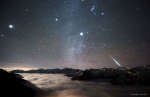 Geminid Fireball over Mount Balang
16.12.2014
This was a sky to remember. While viewing the Geminids meteor shower a few days ago, a bright fireball was captured over Mt. Balang, China with particularly picturesque surroundings. In the foreground, a sea of light clouds slowly floated between dark mountain peaks.
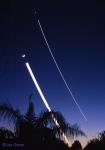 Venus Falls Out of the Evening Sky
3.09.1999
Orbiting closer to the Sun than planet Earth, bright Venus always appears to be near the Sun's position in our sky and often shines near the horizon in twilight hours. In fact, after...
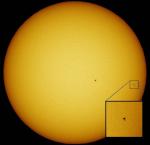 ISS and Discovery Transit the Sun
29.07.2005
That large sunspot near the right edge of the Sun is actually not a sunspot at all. It's the International Space Station (ISS) docked with the Space Shuttle Discovery on mission STS-114.
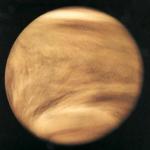 Ultraviolet Venus
7.05.1997
The forecast for Venus is cloudy, cloudy, cloudy. Although similar to the Earth in size and mass, Venus' slightly closer orbit to the Sun create for it a much thicker atmosphere and a much hotter surface. The thick atmosphere was photographed above in ultraviolet light in 1979 by the Pioneer Venus Orbiter.
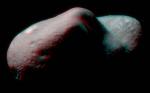 Stereo Eros
24.02.2000
Get out your red/blue glasses and float next to asteroid 433 Eros, 260 million kilometers away! Orbiting the Sun once every 1.8 earth-years, asteroid Eros is a diminutive 40 x 14 x 14 kilometer world of undulating horizons, craters, boulders and valleys.
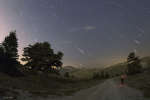 Perseid Meteors over Turkey
1.08.2017
The Perseid Meteor Shower, usually the best meteor shower of the year, will peak late next week. A person watching a clear sky from a dark location might see a bright meteor every minute.
 APOD: 2023 April 30 Б Saturns Moon Helene in Color
30.04.2023
Although its colors may be subtle, Saturn's moon Helene is an enigma in any light. The moon was imaged in unprecedented detail in 2012 as the robotic Cassini spacecraft orbiting Saturn swooped to within a single Earth diameter of the diminutive moon.
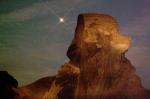 Mars Rising Behind Poodle Rock
13.08.2003
Have you seen Mars lately? As Earth and Mars near their closest approach in nearly 60,000 years on August 27, the red planet has begun to appear dramatically bright and show interesting details through telescopes and binoculars. Although not yet visible at sunset, Mars can be seen rising increasingly earlier in the evening.
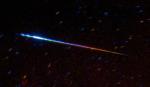 A Perseid Meteor
11.08.1997
Tonight the Perseid Meteor Shower reaches its maximum. Grains of rocky ice will streak across the sky as they evaporate during entry into Earth's atmosphere. These ice chips were shed from Comet Swift-Tuttle. The Perseids result from the annual crossing of the Earth through Comet Swift-Tuttle's orbit.
 APOD: 2025 August 3 Б Milky Way and Exploding Meteor
3.08.2025
In about a week the Perseid Meteor Shower will reach its maximum. Grains of icy rock will streak across the sky as they evaporate during entry into Earth's atmosphere. These grains were shed from Comet Swift-Tuttle.
|
January February March April May June July August September October |
|||||||||||||||||||||||||||||||||||||||||||||||||