
|
You entered: Milky Way
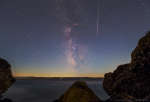 Perseid by the Sea
16.08.2017
Just after moonrise on August 12 this grain of cosmic sand fell by the sea, its momentary flash part of the annual Perseid Meteor Shower. To create the Perseid meteors, dust along the orbit of periodic comet Swift-Tuttle is swept up by planet Earth.
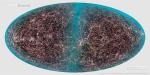 The 2MASS Galaxy Sky
17.09.2003
Are the nearest galaxies distributed randomly? A plot of over one million of the brightest "extended sources" detected by the Two Micron All Sky Survey (2MASS) shows that they are not. The vast majority of these infrared extended sources are galaxies.
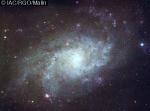 Nearby Spiral M33
21.07.1998
M33 is a prominent nearby spiral galaxy. Nicknamed the Triangulum, M33 is one of the larger members of the Local Group of Galaxies. Two massive spiral galaxies dominate the Local Group: M31 and our Milky Way Galaxy. M33 is the only other spiral galaxy known in the Local Group.
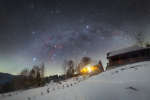 The Northern Winter Hexagon
26.12.2019
December's New Moon brought a solar eclipse to some for the holiday season. It also gave beautiful dark night skies to skygazers around the globe, like this moonless northern winter night. In the scene, bright stars of the Winter Hexagon along the Milky Way are rising.
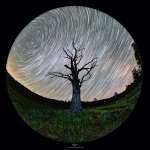 Roots on a Rotating Planet
8.07.2022
With roots on a rotating planet, an old tree is centered in this sequence of 137 exposures each 20 seconds long, recorded one night from northern Sicily. Digital camera and fisheye lens were fixed to a tripod to capture the dramatic timelapse, so the stars trailed through the region's dark sky.
 The Deep Lagoon
28.09.2023
Ridges of glowing interstellar gas and dark dust clouds inhabit the turbulent, cosmic depths of the Lagoon Nebula. Also known as M8, The bright star forming region is about 5,000 light-years distant. It makes for a popular stop on telescopic tours of the constellation Sagittarius toward the center of our Milky Way Galaxy.
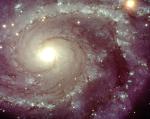 Spiral Galaxy NGC 2997 from VLT
4.08.2002
NGC 2997 is a grand design spiral galaxy. Its small nucleus and sprawling spiral arms give it a type Sc designation. NGC 2997, pictured above, is speeding away from us at about 1100 kilometers...
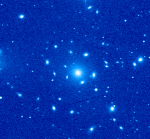 Thousands of Coma Cluster Galaxies
17.09.1995
Almost every object in the above photograph is a galaxy. The Coma Cluster of galaxies pictured is a dense cluster containing many thousands of galaxies. Many of these galaxies contain as many stars as our own Milky Way Galaxy.
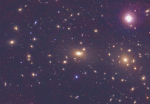 The Coma Cluster of Galaxies
5.11.1996
Almost every object in the above photograph is a galaxy. The Coma Cluster of Galaxies pictured is one of the densest clusters known - it contains thousands of galaxies. Each of these galaxies house billions of stars - just like our own Milky Way Galaxy.
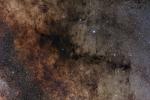 East of Antares
23.06.2006
East of Antares, dark markings seem to sprawl through the crowded star fields toward the center of our Milky Way Galaxy. Cataloged in the early 20th century by astronomer E. E. Barnard, the obscuring interstellar dust clouds include B72, B77, B78, and B59, seen in silhouette against the starry background.
|
January February March April May June July August September October |
|||||||||||||||||||||||||||||||||||||||||||||||||