
|
You entered: full moon
 Lunation
18.02.2001
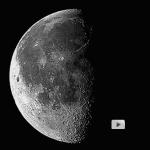
Our Moon's appearance changes nightly. This slow-loading time-lapse sequence shows what our Moon looks like during a lunation, a complete lunar cycle. As the Moon orbits the Earth, the half illuminated by the Sun first becomes increasingly visible, then decreasingly visible. The Moon always keeps the same face toward the Earth.
 Lunation
2.09.2007
Our Moon's appearance changes nightly. This time-lapse sequence shows what our Moon looks like during a lunation, a complete lunar cycle. As the Moon orbits the Earth, the half illuminated by the Sun first becomes increasingly visible, then decreasingly visible. The Moon always keeps the same face toward the Earth.
 Lunation
5.02.2012
Our Moon's appearance changes nightly. This time-lapse sequence shows what our Moon looks like during a lunation, a complete lunar cycle. As the Moon orbits the Earth, the half illuminated by the Sun first becomes increasingly visible, then decreasingly visible. The Moon always keeps the same face toward the Earth.
 Moon AND Sun
7.09.2001
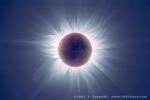
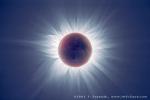
Today's composite image was made from 22 separate pictures of the Moon and Sun all taken from Chisamba, Zambia during the total phase of the 2001 June 21 solar eclipse. The multiple exposures...
 Moon AND Sun
22.11.2003
This composite image was made from 22 separate pictures of the Moon and Sun all taken from Chisamba, Zambia during the total phase of the 2001 June 21 solar eclipse. The multiple exposures were...
 The Crown of the Sun
23.08.2017
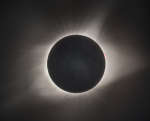
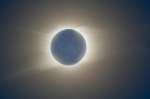
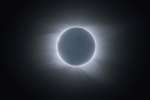
During a total solar eclipse, the Sun's extensive outer atmosphere, or corona, is an inspirational sight. Streamers and shimmering features visible to the eye span a brightness range of over 10,000 to 1, making them notoriously difficult to capture in a single photograph.
 The Crown of the Sun
8.08.2008
During a total solar eclipse, the Sun's extensive outer atmosphere, or corona, is an inspirational sight. The subtle shades and shimmering features of the corona that engage the eye span a brightness range of over 10,000 to 1, making them notoriously difficult to capture in a single picture.
 The Crown of the Sun
21.07.2010
During a total solar eclipse, the Sun's extensive outer atmosphere, or corona, is an inspirational sight. Subtle shades and shimmering features that engage the eye span a brightness range of over 10,000 to 1, making them notoriously difficult to capture in a single photograph.
 APOD: 2025 July 24 Б Titan Shadow Transit
24.07.2025
Every 15 years or so, Saturn's rings are tilted edge-on to our line of sight. As the bright, beautiful ring system grows narrower and fainter it becomes increasingly difficult to see for denizens of planet Earth.
 Io Full Face
29.10.1996
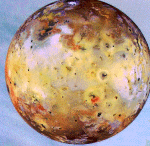
Io is a colorful place. The closest large moon of Jupiter, Io is the most volcanic moon in the Solar System with its surface being completely buried in volcanic lava every few thousand years.
|
January February March April May June July August September October |
|||||||||||||||||||||||||||||||||||||||||||||||||