
|
You entered: massive stars
 APOD: 2023 May 3 Б Centaurus A: A Peculiar Island of Stars
3.05.2023
Galaxies are fascinating. In galaxies, gravity alone holds together massive collections of stars, dust, interstellar gas, stellar remnants and dark matter. Pictured is NGC 5128, better known as Centaurus A. Cen A is the fifth brightest galaxy on the sky and is located at a distance of about 12 million light years from Earth.
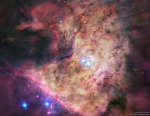 Trapezium: At the Heart of Orion
5.08.2018
Near the center of this sharp cosmic portrait, at the heart of the Orion Nebula, are four hot, massive stars known as the Trapezium. Gathered within a region about 1.5 light-years in radius, they dominate the core of the dense Orion Nebula Star Cluster.
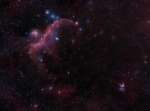 The Seagull and The Duck
19.03.2010
Seen as a seagull and a duck, these nebulae are not the only cosmic clouds to evoke images of flight. But both are winging their way across this broad celestial landscape, spanning almost 7 degrees across planet Earth's night sky toward the constellation Canis Major.
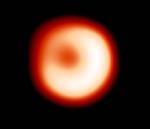 LkHa101: The Hole in the Doughnut
2.03.2001
You'd need a really big cup of coffee with this doughnut ... because the hole in the middle is about a billion kilometers across. Centered on the Sun, a circle that size would lie between the orbits of Mars and Jupiter.
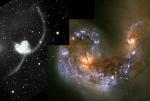 The Antennae Galaxies
22.10.1997
A ground-based telescopic view (left) of the collision between the galaxies NGC4038 and NGC4039 reveals long arcing insect-like "antennae" of luminous matter flung from the scene of the accident. Investigators using the Hubble Space...
 M1: The Crab Nebula
9.11.2023
The Crab Nebula is cataloged as M1, the first object on Charles Messier's famous 18th century list of things which are not comets. In fact, the Crab is now known to be a supernova remnant, debris from the death explosion of a massive star witnessed by astronomers in the year 1054.
 The Tarantula Nebula
17.11.2018
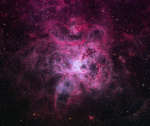
The Tarantula Nebula, also known as 30 Doradus, is more than a thousand light-years in diameter, a giant star forming region within nearby satellite galaxy the Large Magellanic Cloud. About 180 thousand light-years away, it's the largest, most violent star forming region known in the whole Local Group of galaxies.
 Recycling Cassiopeia A
12.07.2002
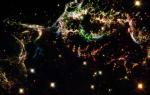
For billions of years, massive stars in our Milky Way Galaxy have lived spectacular lives. Collapsing from vast cosmic clouds, their nuclear furnaces ignite and create heavy elements in their cores. After a few million years, the enriched material is blasted back into interstellar space where star formation begins anew.
 The Densest Galaxy
4.10.2013
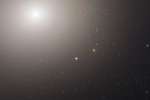
The bright core and outer reaches of giant elliptical galaxy M60 (NGC 4649) loom large at the upper left of this sharp close-up from the Hubble Space Telescope. Some 54 million light-years away and 120,000 light-years across, M60 is one of the largest galaxies in the nearby Virgo Cluster.
 NGC 4449: Close up of a Small Galaxy
14.07.2017
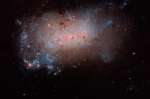
(xxxedit and linkxxx) Grand spiral galaxies often seem to get all the glory. Their young, blue star clusters and pink star forming regions along sweeping spiral arms are guaranteed to attract attention. But small irregular galaxies form stars too, like NGC 4449, about 12 million light-years distant.
|
January February March April |
|||||||||||||||||||||||||||||||||||||||||||||||||