
|
You entered: spiral galaxy
 APOD: 2023 June 7 Б M94: A Double Ring Galaxy
7.06.2023
Most galaxies don't have any rings of stars and gas -- why does M94 have two? First, spiral galaxy M94 has an inner ring of newly formed stars surrounding its nucleus, giving it not only an unusual appearance but also a strong interior glow.
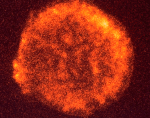 Tychos Supernova Remnant in X ray
7.03.1999
How often do stars explode? By looking at external galaxies, astronomers can guess that these events, known as a supernovae, should occur about once every 30 years in a typical spiral galaxy like our MilkyWay.
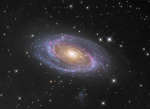 Messier 81
12.03.2021
One of the brightest galaxies in planet Earth's sky is similar in size to our Milky Way Galaxy: big, beautiful Messier 81. Also known as NGC 3031 or Bode's galaxy for its 18th century discoverer, this grand spiral can be found toward the northern constellation of Ursa Major, the Great Bear.
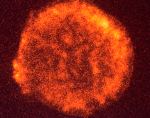 Tycho's Supernova Remnant in X-ray
23.06.1996
How often do stars explode? By looking at external galaxies, astronomers can guess that these events, known as a supernovae, should occur about once every 30 years in a typical spiral galaxy like our MilkyWay.
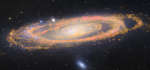 The Infrared Visible Andromeda
12.12.2014
This remarkable synthetic color composite image was assembled from archives of visible light and infrared astronomy image data. The field of view spans the Andromeda Galaxy (M31), a massive spiral a mere 2.5 million light-years away. In fact, with over twice the diameter of our own Milky Way, Andromeda is the largest nearby galaxy.
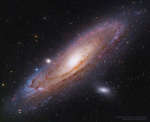 M31: The Andromeda Galaxy
19.01.2022
The most distant object easily visible to the unaided eye is M31, the great Andromeda Galaxy. Even at some two and a half million light-years distant, this immense spiral galaxy -- spanning over 200,000 light years -- is visible, although as a faint, nebulous cloud in the constellation Andromeda.
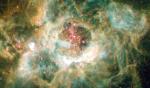 NGC 604: Giant Stellar Nursery
11.04.1998
Scattered within this cavernous nebula, cataloged as NGC 604, are over 200 newly formed hot, massive, stars. At 1,500 light-years across, this expansive cloud of interstellar gas and dust is effectively a giant stellar nursery located some three million light-years distant in the spiral galaxy, M33.
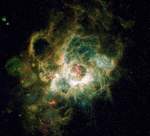 NGC 604: Giant Stellar Nursery in M33
16.08.1996
The nebula cataloged as NGC 604 is a giant star forming region, 1500 light years across, in the nearby spiral galaxy, M33. Seen here in a snapshot by the Hubble Space Telescope, over 200 newly formed, hot, massive, stars are scattered within a cavern-like, gaseous, interstellar cloud.
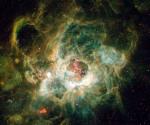 NGC 604: Giant Stellar Nursery
2.11.2002
Scattered within this cavernous nebula, cataloged as NGC 604, are over 200 newly formed hot, massive, stars. At 1,500 light-years across, this expansive cloud of interstellar gas and dust is effectively a giant stellar nursery located some three million light-years distant in the spiral galaxy, M33.
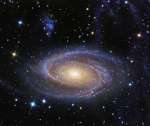 M81 and Arp s Loop
9.12.2010
One of the brightest galaxies in planet Earth's sky and similar in size to the Milky Way, big, beautiful spiral M81 lies 11.8 million light-years away in the northern constellation Ursa Major. This...
|
January February March April May June July August September October |
|||||||||||||||||||||||||||||||||||||||||||||||||