
|
You entered: planets
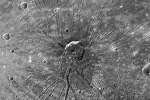 A Spider Shaped Crater on Mercury
4.02.2008
Why does this crater on Mercury look like a spider? When the robotic MESSENGER spacecraft glided by the planet Mercury last month, it was able to image portions of the Sun's closest planet that had never been seen before.
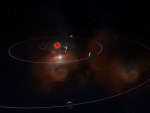 BLG 109: A Distant Version of our own Solar System
18.02.2008
How common are planetary systems like our own? Perhaps quite common, as the first system of planets like our own Solar System has been discovered using a newly adapted technique that, so far, has probed only six planetary systems.
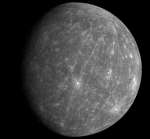 Mercury as Revealed by MESSENGER
8.10.2008
The planet Mercury has been known since history has been recorded, but parts of the Solar System's innermost planet have never been seen like this before. Two days ago the robotic MESSENGER spacecraft buzzed past Mercury for the second time and imaged terrain mapped previously only by comparatively crude radar.
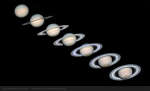 6 Years of Saturn
4.09.2009
Today, planet Earth passes through the plane of Saturn's rings. From the perspective of earthbound astronomers, Saturn's rings will be edge-on. The problem is, Saturn itself is now very close to the Sun, low on horizon after sunset, so good telescopic images will be difficult to come by.
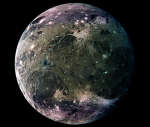 Ganymede Enhanced
20.09.2009
What does the largest moon in the Solar System look like? Ganymede, larger than even Mercury and Pluto, has a surface speckled with bright young craters overlying a mixture of older, darker, more cratered terrain laced with grooves and ridges.
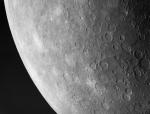 Southwest Mercury
16.02.2003
The planet Mercury resembles a moon. Mercury's old surface is heavily cratered like many moons. Mercury is larger than most moons but smaller than Jupiter's moon Ganymede and Saturn's moon Titan. Mercury is much denser and more massive than any moon, though, because it is made mostly of iron.
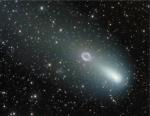 Comet Meets Ring Nebula: Part II
12.05.2006
Moving rapidly through planet Earth's night sky, Fragment C of crumbling comet 73P/Schwassmann-Wachmann 3 passed almost directly in front of M57 - the Ring Nebula, and faint spiral galaxy IC 1296 on May 8.
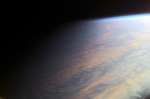 Earth at Twilight
6.04.2013
No sudden, sharp boundary marks the passage of day into night in this gorgeous view of ocean and clouds over our fair planet Earth. Instead, the shadow line or terminator is diffuse and shows the gradual transition to darkness we experience as twilight.
 Active Comet ISON
16.11.2013
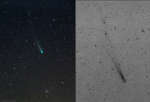
Falling through planet Earth's predawn skies toward its close encounter with the Sun on November 28, Comet ISON is coming to life. The much anticipated comet has now been reported to have substantially increased in brightness, surging to naked-eye visibility for dark sites and sprouting a more complex tail.
 APOD: 2026 April 4 Б Hello World
4.04.2026
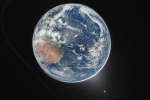
From pole to pole our fair planet is captured in this snapshot from space, an evocative image from a window of the Orion spacecraft Integrity. From the spacecraft's perspective the Sun is moving behind Earth's bright limb along the lower right.
|
January February March April May June July August September October |
|||||||||||||||||||||||||||||||||||||||||||||||||