
|
You entered: young stars
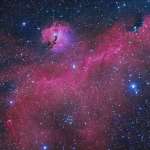 The Seagull Nebula
12.01.2011
This broad expanse of glowing gas and dust presents a bird-like visage to astronomers from planet Earth, suggesting its popular moniker - The Seagull Nebula. This portrait of the cosmic bird covers a 1.6 degree wide swath across the plane of the Milky Way, near the direction of Sirius, alpha star of the constellation Canis Major.
 Pic du Pleiades
9.12.2023
Near dawn on November 19 the Pleiades stood in still dark skies over the French Pyrenees. But just before sunrise a serendipitous moment was captured in this single 3 second exposure; a bright meteor streak appeared to pierce the heart of the galactic star cluster.
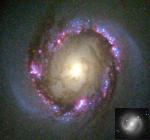 NGC 4314: A Nuclear Starburst Ring
15.06.1998
Is this old galaxy up to new tricks? The barred spiral galaxy NGC 4314 is billions of years old, but its appearance has changed markedly over just the past few millions of years. During that time, a nuclear ring of bright young stars has been evolving.
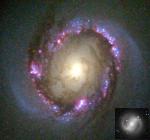 NGC 4314: A Nuclear Starburst Ring
12.12.1999
Is this old galaxy up to new tricks? The barred spiral galaxy NGC 4314 is billions of years old, but its appearance has changed markedly over just the past few millions of years. During that time, a nuclear ring of bright young stars has been evolving.
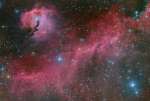 The Seagull Nebula
29.08.2015
A broad expanse of glowing gas and dust presents a bird-like visage to astronomers from planet Earth, suggesting its popular moniker - The Seagull Nebula. This portrait of the cosmic bird covers a 1.6 degree wide swath across the plane of the Milky Way, near the direction of Sirius, alpha star of the constellation Canis Major.
 APOD: 2023 September 19 Б HH 211: Jets from a Forming Star
19.09.2023
Do stars always create jets as they form? No one is sure. As a gas cloud gravitationally contracts, it forms a disk that can spin too fast to continue contracting into a protostar. Theorists hypothesize that this spin can be reduced by expelling jets.
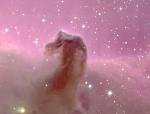 The Horsehead Nebula
16.12.2001
One of the most identifiable nebulae in the sky, the Horsehead Nebula in Orion, is part of a large, dark, molecular cloud. Also known as Barnard 33, the unusual shape was first discovered on a photographic plate in the late 1800s.
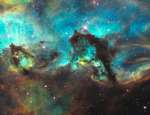 The Seahorse of the Large Magellanic Cloud
29.11.2014
It may look like a grazing seahorse, but the dark object toward the image right is actually a pillar of smoky dust about 20 light years long. The curiously-shaped dust structure occurs in our neighboring Large Magellanic Cloud, in a star forming region very near the expansive Tarantula Nebula.
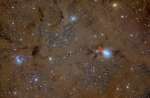 Stardust in Perseus
4.02.2010
This cosmic expanse of dust, gas, and stars covers close to 3 degrees on the sky in the heroic constellation Perseus. Right of center in the gorgeous skyscape is the dusty blue reflection nebula NGC 1333, about 1,000 light-years away. At that estimated distance, the field of view is about 50 light-years across.
 Reflections on VdB 31
13.02.2025
Riding high in the constellation of Auriga, beautiful, blue VdB 31 is the 31st object in Sidney van den Bergh's 1966 catalog of reflection nebulae. It shares this well-composed celestial still life with dark, obscuring clouds B26, B27, and B28, recorded in Edward E. Barnard's 1919 catalog of dark markings in the sky.
|
January February March April May June July August September October |
|||||||||||||||||||||||||||||||||||||||||||||||||