
|
You entered: Earth's atmosphere
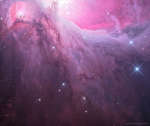 M43: Orion Falls
12.12.2018
Is there a waterfall in Orion? No, but some of the dust in M43 appears similar to a waterfall on Earth. M43, part of the Orion Molecular Cloud Complex, is the often imaged but rarely mentioned neighbor of the more famous M42.
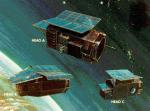 A High Energy Fleet
24.05.1998
Looking like a fleet of futuristic starcruisers, NASA's highly successful series of High Energy Astrophysical Observatory (HEAO) spacecraft appear poised over planet Earth. Labeled A, B, and C in this vintage illustration, the spacebased telescopes were known as HEAO-1, HEAO-2, and HEAO-3 respectively.
 A High Energy Fleet
25.11.2000
Like a fleet of futuristic starcruisers, NASA's highly successful series of High Energy Astrophysical Observatory (HEAO) spacecraft appear poised over planet Earth. Labeled A, B, and C in this vintage illustration, the spacebased telescopes were known as HEAO-1, HEAO-2, and HEAO-3 respectively.
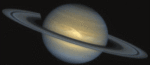 A Storm on Saturn
18.10.1995
The white wisp shown on Saturn's cloud tops is actually a major storm system only discovered in December of 1994. Saturn's clouds are composed of primarily hydrogen and helium, but the storm's white clouds are actually ammonia ice crystals that have frozen upon upheaval to the top of the atmosphere.
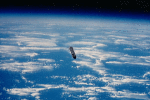 Tanks for the Lift
24.02.1996
Sixteen minutes after the liftoff of STS-29, the Space Shuttle Discovery's jettisoned External Tank (ET) is seen here, in a photograph by shuttle astronaut James P. Bagian, falling back towards Earth. The 154 foot long ET is the largest non-reusable component in the Shuttle system.
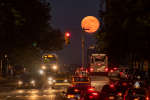 The East 96th Street Moon
30.06.2018
A very full Moon rose over Manhattan's Upper Eastside on June 28, known to some as the Strawberry Moon. Near the horizon, the warm yellow lunar disk was a bit ruffled and dimmed by a long sight-line through dense, hazy atmosphere.
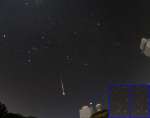 Leonid Fireball over Tenerife
22.11.2011
Historically active, this year's Leonid meteor shower was diminished by bright moonlight. Still, faithful night sky watchers did see the shower peak on November 18 and even the glare of moonlight didn't come close to masking this brilliant fireball meteor.
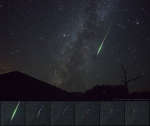 Perseid Fireball at Sunset Crater
19.08.2016
On the night of August 12, this bright Perseid meteor flashed above volcanic Sunset Crater National Monument, Arizona, USA, planet Earth. Streaking along the summer Milky Way, its initial color is likely due to the shower meteor's characteristically high speed.
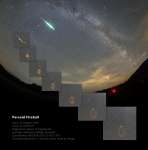 Perseid Fireball and Persistent Train
17.08.2018
Before local midnight on August 12, this brilliant Perseid meteor flashed above the Poloniny Dark Sky Park, Slovakia, planet Earth. Streaking beside the summer Milky Way, its initial color is likely due to the shower meteor's characteristically high speed.
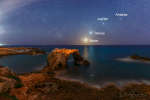 Celestial Alignment over Sicilian Shore
4.03.2019
This was a sunrise to remember. About a month ago, just before the dawn of the Sun, an impressive alignment of celestial objects was on display to the east. Pictured, brightest and closest to the horizon, is the Moon.
|
January February March April May June July August September October |
|||||||||||||||||||||||||||||||||||||||||||||||||