
|
You entered: Earth orbit
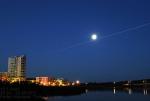 Moons and Bright Mars
1.08.2003
In this serene view, the moons of Earth along with the bright planet Mars shine above the city of Turku near the southwestern tip of Finland. Of course Earth's large natural satellite, the Moon, at a distance of 400,000 kilometers, is by far the brightest object in this sky.
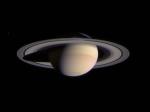 Cassini Closes in on Saturn
1.03.2004
Are they gone? They were not originally predicted to even be there. The mystery revolves around strange shadow-like spokes that appeared on Saturn's large B-ring, the large middle ring in the complex system of particles that orbits Saturn.
 To Fly Free in Space
1.01.2012
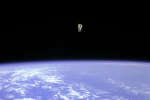
At about 100 meters from the cargo bay of the space shuttle Challenger, Bruce McCandless II was farther out than anyone had ever been before. Guided by a Manned Maneuvering Unit (MMU), astronaut McCandless, pictured above, was floating free in space.
 To Fly Free in Space
31.12.2017
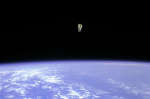
What would it be like to fly free in space? At about 100 meters from the cargo bay of the space shuttle Challenger, Bruce McCandless II was living the dream -- floating farther out than anyone had ever been before. Guided by a Manned Maneuvering Unit (MMU), astronaut McCandless, pictured, was floating free in space.
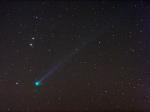 Unexpected Comet Pojmanski Now Visible
6.03.2006
Have you ever seen a comet? Comets bright enough to be visible to the unaided eye appear only every few years. Right now, however, a new comet has brightened unexpectedly and is visible as a faint streak to the unaided northern observer in the eastern morning sky just before sunrise. Binoculars may help.
 APOD: 2025 September 16 Б New Comet SWAN25B over Mexico
16.09.2025
A newly discovered comet is already visible with binoculars. The comet, C/2025 R2 (SWAN) and nicknamed SWAN25B, is brightening significantly as it emerges from the Sun's direction and might soon become visible on your smartphone -- if not your eyes.
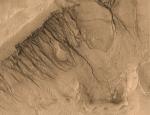 Unusual Gullies and Channels on Mars
5.02.2003
What could have formed these unusual channels? Inside Newton Basin on Mars, numerous narrow channels run from the top down to the floor. The above picture covers a region spanning about 1500 meters across.
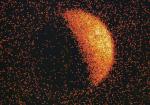 X-Ray Moon
4.10.2003
This x-ray image of the Moon was made by the orbiting ROSAT (Röntgensatellit) Observatory in 1990. In this digital picture, pixel brightness corresponds to x-ray intensity. Consider the image in three parts: the bright hemisphere of the x-ray moon, the darker half of the moon, and the x-ray sky background.
 APOD: 2025 January 7 Б A New Years Aurora and SAR Arc
7.01.2025
It was a new year, and the sky was doubly red. The new year meant that the Earth had returned to its usual place in its orbit on January 1, a place a few days before its closest approach to the Sun.
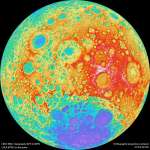 A Colorful Side of the Moon
18.11.2011
This colorful topographical map of the Moon is centered on the lunar farside, the side not seen from planet Earth. That view is available to the Lunar Reconnaissance Orbiter though, as the spacecraft's wide angle camera images almost the entire lunar surface every month.
|
January February March April May June July August September October |
|||||||||||||||||||||||||||||||||||||||||||||||||