
|
You entered: Moon
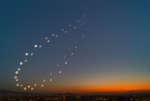 A Double Lunar Analemma over Turkey
10.10.2022
An analemma is that figure-8 curve you get when you mark the position of the Sun at the same time each day for one year. But the trick to imaging an analemma of the Moon is to wait bit longer.
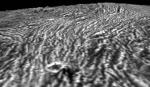 Oceans Under Jupiter's Ganymede
18.12.2000
The search for extraterrestrial life came back into our own Solar System last week with the announcement that there may be liquid oceans under the surface of Jupiter's moon Ganymede. Ganymede now joins Callisto and Europa as moons of Jupiter that may harbor seas of liquid water under layers of surface ice.
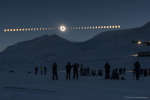 Total Solar Eclipse over Svalbard
20.04.2015
Going, going, gone. That was the feeling in Svalbard, Norway last month during a total eclipse of the Sun by the Moon. In the featured image, the eclipse was captured every three minutes and then digitally merged with a foreground frame taken from the same location.
 La Palma Eclipse Sequence
7.10.2015
At left, a dramatic image sequence follows late September's total lunar eclipse above a rugged landscape and sea of clouds from the Canary island of La Palma. Composited in a circular fisheye projection...
 Moonrise Over Turkey
16.06.2009
Is the Moon larger when near the horizon? No -- as shown above, the Moon appears to be very nearly the same size no matter its location on the sky. Oddly, the cause or causes for the common Moon Illusion are still being debated.
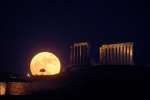 Solstice Moonrise, Cape Sounion
20.06.2008
Today's solstice marks the northernmost point of the Sun's annual motion through planet Earth's sky and the astronomical beginning of the northern hemisphere's summer. But only two days ago, the Full Moon nearest the solstice rose close to the ecliptic plane opposite the Sun, near its southernmost point for the year.
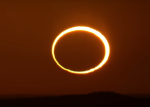 A Ring of Fire Sunrise Solar Eclipse
15.06.2020
What's rising above the horizon behind those clouds? It's the Sun. Most sunrises don't look like this, though, because most sunrises don't include the Moon. In the early morning of 2013 May 10, however, from Western Australia, the Moon was between the Earth and the rising Sun.
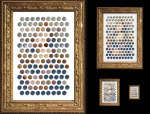 The Moona Lisa
16.10.2021
Only natural colors of the Moon in planet Earth's sky appear in this creative visual presentation. Arranged as pixels in a framed image, the lunar disks were photographed at different times. Their varying hues are ultimately due to reflected sunlight affected by changing atmospheric conditions and the alignment geometry of Moon, Earth, and Sun.
 The Moona Lisa
14.09.2024
Only natural colors of the Moon in planet Earth's sky appear in this creative visual presentation. Arranged as pixels in a framed image, the lunar disks were photographed at different times. Their varying hues are ultimately due to reflected sunlight affected by changing atmospheric conditions and the alignment geometry of Moon, Earth, and Sun.
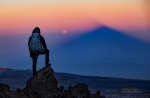 Moonrise and Mountain Shadow
14.03.2020
What phase of the Moon is 3.14 radians from the Sun? The Full Moon, of course. Even though the Moon might look full for several days, the Moon is truly at its full phase when it is 3.14 radians (aka 180 degrees) from the Sun in ecliptic longitude.
|
January February March April May June July August September October |
|||||||||||||||||||||||||||||||||||||||||||||||||