
|
You entered: full moon
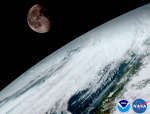 GOES 16: Moon over Planet Earth
26.01.2017
Launched last November 19 from Cape Canaveral Air Force Station, the satellite now known as GOES-16 can now observe planet Earth from a geostationary orbit 22,300 miles above the equator. Its Advanced Baseline Imager captured this contrasting view of Earth and a gibbous Moon on January 15.
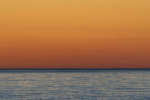 Find the New Moon
25.07.2022
Can you find the Moon? This usually simple task can be quite difficult. Even though the Moon is above your horizon half of the time, its phase can be anything from crescent to full.
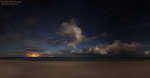 Moonbow Beach
6.09.2014
Like a rainbow at night, a beautiful moonbow shines above the western horizon in this deserted beach scene from Molokai Island, Hawaii, USA, planet Earth. Captured last June 17 in early morning hours, the lights along the horizon are from Honolulu and cities on the island of Oahu some 30 miles away.
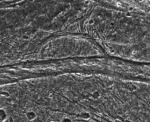 Mysterious Features on Ganymede
9.12.1997
Where is the rest of the circle? Jupiter's largest moon Ganymede has some truly unusual terrain, including the pictured half circle above cut by nearly parallel curves. Full circles can be easily explained by impact craters, but partial circles imply that some resurfacing has occurred since the original impact.
 Mercury And The Moon
11.11.1999
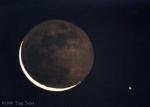
Mercury is the closest planet to the Sun and never moves far from our parent star in Earth's sky. Racing around its tight orbit, this well-done world is a little over 1/3 the diameter of Earth and is often lost to our view in the solar glare.
 Lunar View, Solar Eclipse
31.08.2017
Orbiting above the lunar nearside on August 21, the Lunar Reconnaissance Orbiter turned to look back on a bright, Full Earth. As anticipated its Narrow Angle Camera scanned this sharp view of our fair...
 Bright Venus
8.03.2001
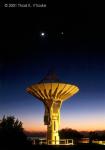
Have you seen a bright evening star in the western sky lately? That's no star, that's planet Venus the second "rock" from the Sun. Blazing at -4.6 magnitude, Venus, after the Sun and Moon, is the third brightest celestial body in planet Earth's sky.
 A Solar Eclipse Quilt
13.11.2012
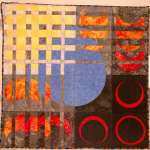
Some people are so inspired by solar eclipses that they quilt. Pictured above is a resulting textile from one such inspiration. The 38x38 inch quilt offers impressions of a total annular eclipse, when the Moon is too far from the Earth to cover the entire Sun, witnessed in Spain in October of 2005.
 Saturn the Giant
9.11.2019
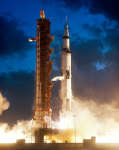
On May 25, 1961 U.S. president John Kennedy announced the goal of landing astronauts on the Moon by the end of the decade. By November 9, 1967 this Saturn V rocket was ready for launch and the first full test of its capabilities on the Apollo 4 mission.
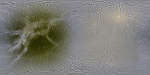 The Map of Dione
6.11.2014
This cylindrical projection global map is one of six new color maps of Saturn's midsized icy moons, constructed using 10 years of image data from the Cassini spacecraft. Discovered by Cassini (the astronomer) in 1684, Dione is about 1,120 kilometers across.
|
January February March April May June July August September October |
|||||||||||||||||||||||||||||||||||||||||||||||||