
|
You entered: Earth's atmosphere
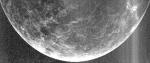 A Radar Image of Venus
15.05.2001
The largest radio telescopes in the world are working together to create a new map of the surface of Venus. The surface of Venus is unusually hidden by a thick atmosphere of mostly carbon dioxide gas. These thick clouds are transparent, however, to radar signals sent and received from Earth.
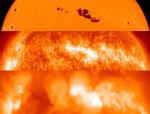 Sunspot Stack
19.04.2001
Welcome to multiwavelength astronomy! From top to bottom, these stacked panels show the largest sunspot group in a decade in visible, extreme ultraviolet, and x-ray light. All were taken on March 29, around...
 APOD: 2023 July 17 Б Shells and Arcs around Star CW Leonis
17.07.2023
What's happening around this star? No one is sure. CW Leonis is the closest carbon star, a star that appears orange because of atmospheric carbon dispersed from interior nuclear fusion. But CW Leonis also appears engulfed in a gaseous carbon-rich nebula.
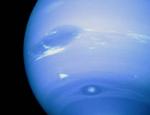 Dark Spots on Neptune
21.08.2001
Neptune has spots. The Solar System's outermost gas giant shows a nearly uniform blue hue created by small amounts of methane drifting in a thick atmosphere of nearly colorless hydrogen and helium. Dark spots do appear, however, that are anti-cyclones: large high-pressure systems that swirl in Neptune's cold cloud tops.
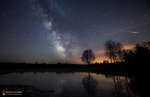 Halley Dust and Milky Way
9.05.2014
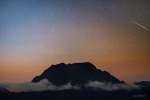
The early morning hours of May 6 were moonless when grains of cosmic dust streaked through dark skies. Swept up as planet Earth plows through dusty debris streams left behind periodic Comet Halley, the annual meteor shower is known as the Eta Aquarids.
 Comet Halley vs Comet SWAN
14.05.2020
The pre-dawn hours of May 3rd were moonless as grains of cosmic dust streaked through southern skies above Reunion Island. Swept up as planet Earth plowed through dusty debris streams left behind periodic Comet 1/P Halley, the annual meteor shower is known as the Eta Aquarids.
 Mars near Opposition
11.04.2014
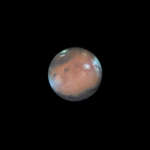
Tonight Mars is between opposition (April 8) and closest approach (April 14) looping through the constellation Virgo opposite the Sun in the night sky. That makes it prime season for telescopic views of the the Red Planet, like this one from April 3rd.
 Impact! 65 Million Years Ago
12.10.1997
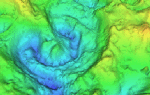
What killed the dinosaurs? Their sudden disappearance 65 million years ago, along with about 70 percent of all species then living on Earth, is known as the K-T event (Cretaceous-Tertiary Mass Extinction event). Geologists and paleontologists often entertain the idea of a large asteroid
 Impact! 65 Million Years Ago
4.06.1996
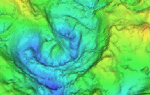
What killed the dinosaurs? Their sudden disappearence 65 million years ago, along with about 70 percent of all species then living on Earth, is known as the K-T event (Cretaceous-Tertiary Mass Extinction event). Geologists and paleontologists often entertain the idea of a large asteroid or comet impacting the Earth as the culprit.
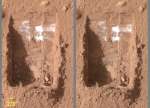 Vanishing Act
21.06.2008
Compare these two close-up pictures taken on sol 20 (left) and sol 24 of a trench dug in the Martian surface by NASA's Phoenix Lander. Those sols of the Phoenix Mission (a sol is a Martian day), correspond to June 15 and 18 on planet Earth.
|
January February March April May June July August September October |
|||||||||||||||||||||||||||||||||||||||||||||||||