
|
You entered: Earth orbit
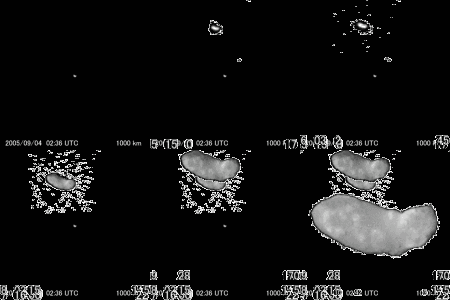 Approaching Asteroid Itokawa
19.09.2005
What are asteroids made of? To help find out, Japan's JAXA space agency launched the Hayabusa mission to rendezvous with asteroid Itokawa. Last week, the small robotic Hayabusa spacecraft arrived at asteroid Itokawa and stationed itself only 20 kilometers away.
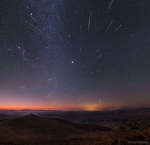 Geminid Meteors over Chile
7.12.2019
Are meteors streaming out from a point in the sky? Yes, in a way. When the Earth crosses a stream of Sun-orbiting meteors, these meteors appear to come from the direction of the stream -- with the directional point called the radiant.
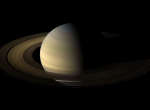 Saturn at Equinox
21.09.2014
How would Saturn look if its ring plane pointed right at the Sun? Before August 2009, nobody knew. Every 15 years, as seen from Earth, Saturn's rings point toward the Earth and appear to disappear.
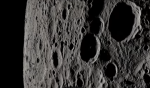 Apollo 13 Views of the Moon
2.03.2020
What if the only way to get back to Earth was to go around the far side of the Moon? Such was the dilemma of the Apollo 13 Crew in 1970 as they tried to return home in their unexpectedly damaged spacecraft.
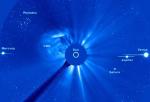 Pleiades, Planets, And Hot Plasma
24.05.2000
Bright stars of the Pleiades, four planets, and erupting solar plasma are all captured in this spectacular image from the space-based SOlar and Heliospheric Observatory (SOHO). In the foreground of the 15 degree wide field of view, a bubble of hot plasma, called a Coronal Mass Ejection (CME)
 Galileo s Europa
28.03.2024
Looping through the Jovian system in the late 1990s, the Galileo spacecraft recorded stunning views of Europa and uncovered evidence that the moon's icy surface likely hides a deep, global ocean. Galileo...
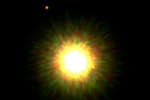 Companion of a Young, Sun-like Star Confirmed
4.07.2010
The first direct image of an extrasolar planet orbiting a star similar to our Sun has been confirmed. Located just 500 light-years away toward the constellation Scorpius, the parent star, cataloged as 1RXS J160929.1-210524, is only slightly less massive and a little cooler than the Sun.
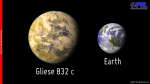 Gliese 832c: The Closest Potentially Habitable Exoplanet
9.07.2014
This planet is only 16 light years away -- could it harbor life? Recently discovered exoplanet Gliese 832c has been found in a close orbit around a star that is less bright than our Sun.
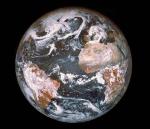 An Earth Ornament
24.12.1999
The Apollo 8 astronauts spent the 1968 Christmas Season orbiting the Moon, returning with striking images of both Moon and Earth from space - pictures which inspired the world. While in lunar orbit...
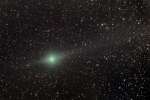 Comet Lulin Approaches
1.02.2009
How bright will Comet Lulin become? No one knows for sure. Although it is notoriously difficult to accurately predict the brightness of newly discovered comets, Comet Lulin could well become visible to the unaided eye later this month.
|
January February March April May June July August September October |
|||||||||||||||||||||||||||||||||||||||||||||||||