
|
You entered: clouds
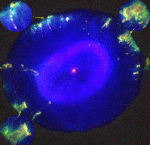 Fliers Around the Blue Snowball Nebula
21.11.1996
Planetary nebulae are strange. First, they are gas clouds and have nothing to do with our Solar System's planets. Next, although hundreds of planetary nebulae have been catalogued and thousands surely exist in our Galaxy, aspects of the formation process are still debated.
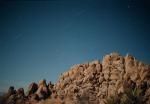 Leonids Over Indian Cove
17.11.2003
One year ago today an impressive meteor shower graced the skies of Earth. Pictured above from last year, at least six bright meteors are visible in only part of the sky above Indian Cove campground in California, USA, during a four-minute exposure.
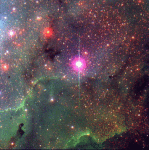 Starbirth in the Lagoon Nebula
24.10.1996
Stars are forming even today in the Lagoon Nebula. This bright nebula is visible in the constellation of Sagittarius with binoculars. The above photo is the result of a new sensitive camera being attached to one of the world's largest telescopes.
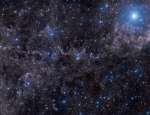 Stars in a Dusty Sky
28.09.2012
Bright star Markab anchors this dusty skyscape. At the top right corner of the frame, Markab itself marks a corner of an asterism known as the Great Square, found within the boundaries of the constellation Pegasus, the flying horse.
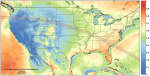 Where to See the American Eclipse
30.01.2017
Are you planning to see the American Eclipse on August 21? A few hours after sunrise, a rare total eclipse of the Sun will be visible along a narrow path across the USA. Those only near the path will see a partial eclipse.
 APOD: 2024 April 23 Б Contrail Shadow X
22.04.2024
What created this giant X in the clouds? It was the shadow of contrails illuminated from below. When airplanes fly, humid engine exhaust may form water droplets that might freeze in Earth's cold upper atmosphere. These persistent streams of water and ice scatter light from the Sun above and so appear bright from below.
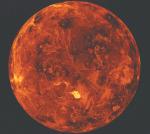 The North Pole of Venus
14.05.2003
If you could look down on the North Pole of Venus what would you see? The Magellan probe that orbited Venus from 1990 to 1994 was able to peer through the thick Venusian clouds and build up the above image by emitting and re-detecting cloud-penetrating radar.
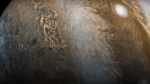 Passing Jupiter
25.02.2018
Here comes Jupiter! NASA's robotic spacecraft Juno is continuing on its 53-day, highly-elongated orbits around our Solar System's largest planet. The featured video is from perijove 11, the eleventh time Juno has passed near Jupiter since it arrived in mid-2016.
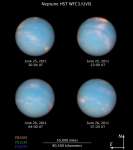 Neptune: Once Around
14.07.2011
Neptune rotates once on its axis in about 16 hours. So, spaced about 4 hours apart these 4 images of the solar system's most distant gas giant cover one Neptune day. Recorded...
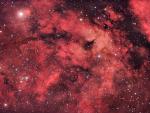 A Cygnus Star Field
28.07.2004
In the constellation of the swan near the nebula of the pelican lies the gas cloud of the butterfly surrounding a star known as the hen. That star, given the proper name Sadr, is visible to the unaided eye but found here as the brightest object on the upper left.
|
January February March April May June July August September October |
|||||||||||||||||||||||||||||||||||||||||||||||||