
|
You entered: cluster
 APOD: 2025 June 24 Б In the Center of Spiral Galaxy M61
24.06.2025
Is there a spiral galaxy in the center of this spiral galaxy? Sort of. Image data from the Hubble Space Telescope, the European Southern Observatory, and smaller telescopes on planet Earth are combined in this detailed portrait of face-on spiral galaxy Messier 61 (M61) and its bright center.
 The Planet, the White Dwarf, and the Neutron Star
18.07.2003
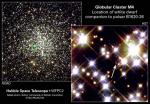
A planet, a white dwarf, and a neutron star orbit each other in the giant globular star cluster M4, some 5,600 light-years away. The most visible member of the trio is the white...
 NGC 1 and NGC 2
19.08.2005
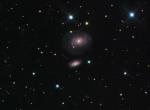
Beautiful nebulae, clusters, and galaxies that grace planet Earth's night sky are often known by their New General Catalog designation or NGC number. That classic listing was compiled by John Louis Emil Dreyer, remarkable director of the Armagh Observatory from 1882 to 1916.
 The Sloan Great Wall: Largest Known Structure
7.11.2007
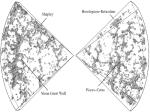
What is the largest structure known? The answer might depend on how one defines "structure." A grouping of galaxies known as the Sloan Great Wall was discovered in the Sloan Digital Sky Survey and is a leading candidate.
 Comet Garradd and Messier 15
6.08.2011
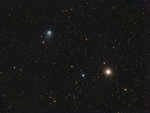
Recorded on August 2, this telescopic composite image catches Comet Garradd (C/2009 P1) in the same field of view as globular star cluster M15. The celestial scene would have been a rewarding one for influential 18th century comet hunter Charles Messier.
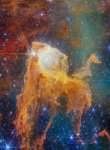 A Treasure Chest in the Carina Nebula
17.09.2026
This treasure chest is full of stars. The featured image was obtained with NASA's James Webb Space Telescope and shows a dust pilar in the Carina Nebula inside our Galaxy, roughly 7500 light-years away.
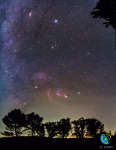 Comet Lovejoy in a Winter Sky
27.01.2015
Which of these night sky icons can you find in this beautiful and deep exposure of the northern winter sky? Skylights include the stars in Orion's belt, the Orion Nebula, the Pleiades star cluster, the bright stars Betelgeuse and Rigel, the California Nebula, Barnard's Loop, and Comet Lovejoy.
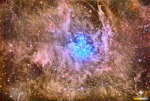 The Pleiades Deep and Dusty
14.11.2017
The well-known Pleiades star cluster is slowly destroying part of a passing cloud of gas and dust. The Pleiades is the brightest open cluster of stars on Earth's sky and can be seen from almost any northerly location with the unaided eye.
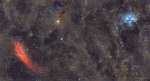 Seven Sisters versus California
5.04.2022
On the upper right, dressed in blue, is the Pleiades. Also known as the Seven Sisters and M45, the Pleiades is one of the brightest and most easily visible open clusters on the sky. The Pleiades contains over 3,000 stars, is about 400 light years away, and only 13 light years across.
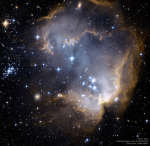 APOD: 2026 April 13 Б NGC 602 and Beyond
13.04.2026
The clouds may look like an oyster, and the stars like pearls, but look beyond. Near the outskirts of the Small Magellanic Cloud, a satellite galaxy some 200 thousand light-years distant, lies 5 million year young star cluster NGC 602.
|
January February March April May June July August September October |
|||||||||||||||||||||||||||||||||||||||||||||||||