
|
You entered: dark nebula
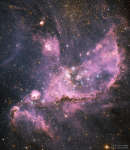 NGC 346: Star Forming Cluster in the SMC
30.11.2020
Are stars still forming in the Milky Way's satellite galaxies? Found among the Small Magellanic Cloud's (SMC's) clusters and nebulas, NGC 346 is a star forming region about 200 light-years across, pictured here in the center of a Hubble Space Telescope image.
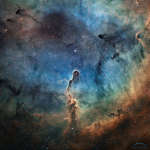 The Elephants Trunk in IC 1396
12.10.2015
Like an illustration in a galactic Just So Story, the Elephant's Trunk Nebula winds through the emission nebula and young star cluster complex IC 1396, in the high and far off constellation of Cepheus. Of course, the cosmic elephant's trunk is over 20 light-years long.
 The Elephant's Trunk in IC 1396
5.11.2010
Like an illustration in a galactic Just So Story, the Elephant's Trunk Nebula winds through the emission nebula and young star cluster complex IC 1396, in the high and far off constellation of Cepheus. Of course, the cosmic elephant's trunk is over 20 light-years long.
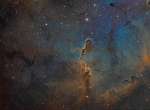 The Elephant s Trunk in IC 1396
26.07.2013
Like an illustration in a galactic Just So Story, the Elephant's Trunk Nebula winds through the emission nebula and young star cluster complex IC 1396, in the high and far off constellation of Cepheus. Of course, the cosmic elephant's trunk is over 20 light-years long.
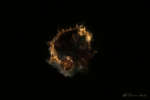 A Falcon 9 Nebula
3.09.2021
Not the Hubble Space Telescope's latest view of a distant galactic nebula, this illuminated cloud of gas and dust dazzled early morning spacecoast skygazers on August 29. The snapshot was taken at 3:17am from Space View Park in Titusville, Florida.
 On the Road to Carina
18.02.2012
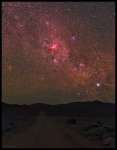
This rugged road through the dark Atacama Desert seems to lead skyward toward the bright stars and glowing nebulae of the southern Milky Way. If you follow the road you will get to Cerro Armazones peak in Chile, future construction site for the 40-meter class European Extremely Large Telescope.
 APOD: 2025 May 20 Б Milky Way over Maunakea
19.05.2025
Have you ever seen the band of our Milky Way Galaxy? In a clear sky from a dark location at the right time, a faint band of light becomes visible across the sky. Soon after your eyes become dark adapted, you might spot the band for the first time. It may then become obvious.
 The Brown Dwarfs of Orions Trapezium
30.08.2000
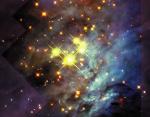
The bright stars above are well known as heart of the Trapezium, an open cluster of stars in the center of the Orion Nebula. The many dim objects, however, are not well known, and have come to attention only on recent images in infrared light.
GB-finalLeshin1024.preview.jpg) The Elephant s Trunk Nebula in Cepheus
The Elephant s Trunk Nebula in Cepheus
18.01.2017
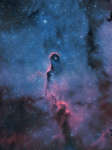
Like an illustration in a galactic Just So Story, the Elephant's Trunk Nebula winds through the emission nebula and young star cluster complex IC 1396, in the high and far off constellation of Cepheus. Also known as vdB 142, the cosmic elephant's trunk is over 20 light-years long.
 The Elephant's Trunk Nebula in Cepheus
31.07.2020
Like an illustration in a galactic Just So Story, the Elephant's Trunk Nebula winds through the emission nebula and young star cluster complex IC 1396, in the high and far off constellation of Cepheus. Also known as vdB 142, the cosmic elephant's trunk is over 20 light-years long.
|
January February March April May June July August September October |
|||||||||||||||||||||||||||||||||||||||||||||||||