
|
You entered: full moon
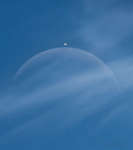 APOD: 2026 September 15 Б A Daytime Eclipse: Moon Occults Venus
15.09.2026
There was something behind the clouds. Upon close inspection, it was the Moon, which was hard to see yesterday around noon above the small village of Cessy, France. But soon, it was not only the Moon. As expected, a bright dot suddenly appeared from behind the Moon -- the planet Venus far in the distance.
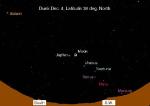 A Sky Full Of Planets
4.12.1997
Look up tonight. Just after sunset, the crescent moon and all five "naked-eye" planets (Mercury, Venus, Mars, Jupiter, and Saturn) will be visible (depending on your latitude), lying near our solar system's ecliptic plane.
 APOD: 2023 September 17 Б Moon Mountains Magnified during Ring of Fire Eclipse
17.09.2023
What are those dark streaks in this composite image of a solar eclipse? They are reversed shadows of mountains at the edge of the Moon. The center image, captured from Xiamen, China, has the Moon's center directly in front of the Sun's center.
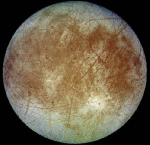 Europa Full Face
20.11.1996
What mysteries might be solved by peering into this crystal ball? This crystal ball is quite unusual because it is actually a moon of Jupiter, the crystals are ice-crystals, and the ball is not only dirty and opaque but cracked beyond repair.
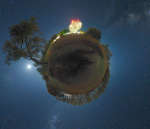 The Planet and the Radio Dish
3.08.2010
What planet is this? Although seemingly something out of The Little Prince, the planet is actually Earth. More specifically, it is a small part of the Earth incorporated into a four image stereographic "Little Planet " projection.
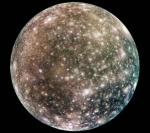 Callisto Full Face
20.01.2002
Callisto's surface shows its age. While probably formed at the same time as Io, the difference between the surfaces of these two moons of Jupiter could hardly be greater. Io's surface is young, shows practically no impact craters, and is continually being repaved by the lava exploding from its many large volcanoes
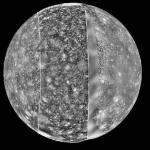 Callisto Full Face
9.12.1996
Callisto's surface shows its age. While probably formed at the same time as Io, the difference between the surfaces of these two moons of Jupiter could hardly be greater. Io's surface is young, shows practically no impact craters, and is continually being repaved by the lava exploding from its many large volcanoes.
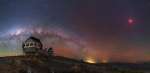 Eclipsed in Southern Skies
1.10.2015
This stunning panorama in southern skies was recorded on the colorful night of September 27/28 from Carngegie Las Campanas Observatory. A diffuse glow and dark rifts of the central Milky Way hang over domes of the twin 6.5 meter Magellan telescopes. But most eye-catching is the deep red glow of the Moon.
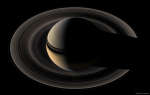 Crescent Saturn
8.08.2020
From Earth, Saturn never shows a crescent phase. But when viewed from a spacecraft the majestic giant planet can show just a sunlit slice. This image of crescent Saturn in natural color was taken by the robotic Cassini spacecraft in 2007.
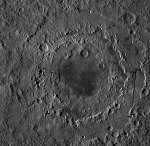 Mare Orientale
12.03.2011
Shaped like a target ring bull's-eye, the Mare Orientale is one of the most striking large scale lunar features. Located on the Moon's extreme western edge, it is unfortunately difficult to see from an earthbound perspective.
|
January February March April May June July August September October |
|||||||||||||||||||||||||||||||||||||||||||||||||