
|
You entered: Earth orbit
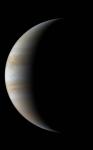 Farewell Jupiter
8.08.2001
Next stop: Saturn. The Cassini spacecraft, launched from Earth four years ago, has now swung past Jupiter and should arrive at Saturn in the year 2004. Pictured to the left is a parting shot from Cassini in January that would not have been possible from Earth: Jupiter showing a crescent phase.
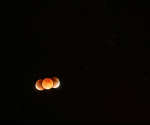 Earthshadow and the Beehive
3.02.2018
The Earth's dark umbral shadow is shaped like a cone extending into space. Of course its circular cross section at the distance of the Moon is more easily seen during a lunar eclipse.
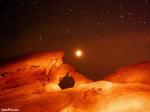 Mars to Appear Normal this August
8.08.2005
Will Mars appear extremely close and bright later this month? No. Regardless of numerous urban legends circulating, Mars will a relatively normal August. October is the best month to see Mars this year. The red planet is now visible in the morning before sunrise.
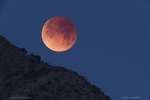 Moonset Eclipse
1.02.2018
Near the closest point in its orbit, the second Full Moon of the month occurred on January 31. So did the first Total Lunar Eclipse of 2018, as the Moon slid through planet Earth's shadow.
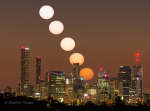 Aphelion Sunrise
5.07.2017
On July 3rd, planet Earth reached aphelion, the farthest point in its elliptical orbit around the Sun. Each year, this day of the most distant Sun happens to occur during winter in the southern hemisphere.
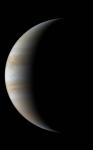 Farewell Jupiter
8.08.2001
Next stop: Saturn. The Cassini spacecraft, launched from Earth four years ago, has now swung past Jupiter and should arrive at Saturn in the year 2004. Pictured to the left is a parting shot from Cassini in January that would not have been possible from Earth: Jupiter showing a crescent phase.
 APOD: 2025 September 22 Б Equinox at Saturn
22.09.2025
On Saturn, the rings tell you the season. On Earth, today marks an equinox, the time when the Earth's equator tilts directly toward the Sun. Since Saturn's grand rings orbit along...
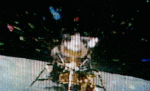 Blasting Off from the Moon
13.12.1998
How did the astronauts get back from the Moon? The Lunar Module that landed two astronauts on the Moon actually came apart. The top part containing the astronauts carried additional rocket fuel which allowed it to blast away, leaving the bottom part on the Moon forever.
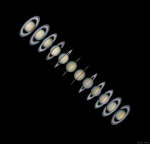 Rings and Seasons of Saturn
19.09.2021
On Saturn, the rings tell you the season. On Earth, Wednesday marks an equinox, the time when the Earth's equator tilts directly toward the Sun. Since Saturn's grand rings orbit along...
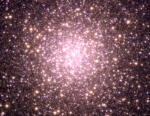 Globular Cluster M3
6.12.1996
This huge ball of stars predates our Sun. Long before mankind evolved, before dinosaurs roamed, and even before our Earth existed, ancient globs of stars condensed and orbited a young Milky Way Galaxy.
|
January February March April May June July August September October |
|||||||||||||||||||||||||||||||||||||||||||||||||