
|
You entered: Milky Way
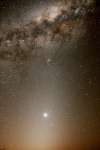 Venus, Zodiacal Light, and the Galactic Center
18.10.2013
The bulging center of our Milky Way Galaxy rests on a pillar of light in this luminous skyscape. Recorded on September 22nd in dark South African skies, rivers of dust seem to flow downward from the galactic center towards Antares, yellowish alpha star of the constellation Scorpius, near the top of the scene.
 APOD: 2025 December 16 Б Andromeda and Sprites over Australia
16.12.2025
WhatБs happening over that tree? Two very different things. On the left is the Andromeda galaxy, an object that is older than humanity and will last billions of years into the future. Andromeda (M31) is similar in size and shape to our own Milky Way Galaxy.
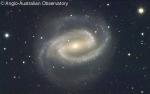 Barred Spiral Galaxy NGC 1300
4.10.2000
NGC 1300 is a large spiral galaxy that appears as a flattened figure eight. A huge bar that spans over 150,000 light-years across the galaxy center dominates its appearance. The picturesque galaxy lies about 75 million light-years distant, so that light that we see now left during the age of the dinosaurs.
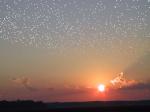 A Flock of Stars
5.10.2001
Only a few stars can be found within ten light-years of our lonely Sun, situated near an outer spiral arm of the Milky Way galaxy. But if our Sun were found within a star cluster, thousands of stars might occupy a similar space.
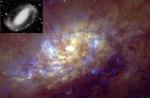 Starbirth in NGC 1808
23.03.1998
The center of galaxy NGC 1808 is bursting with new stars, but why? Being a barred spiral galaxy makes NGC 1808 somewhat similar to our own Milky Way Galaxy. But the disk of NGC 1808 (inset) is quite warped, and its center is unusually bright and blue.
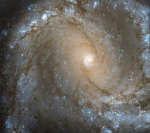 In the Center of Spiral Galaxy M61
20.05.2014
M61 is a barred spiral galaxy located in the nearby Virgo Cluster of Galaxies. Visible in M61 are a host of features common to spiral galaxies: bright spiral arms, a central bar, dust lanes, and bright knots of stars. M61, also known as NGC 4303, in similar to our own Milky Way Galaxy.
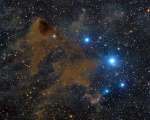 Lynds Dark Nebula 183
21.10.2017
Beverly Lynds Dark Nebula 183 lies a mere 325 light-years away, drifting high above the plane of our Milky Way Galaxy. Obscuring the starlight behind it when viewed at optical wavelengths, the dark, dusty molecular cloud itself seems starless.
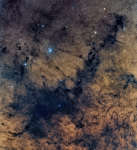 The Pipe Nebula
7.08.2020
East of Antares, dark markings sprawl through crowded star fields toward the center of our Milky Way Galaxy. Cataloged in the early 20th century by astronomer E. E. Barnard, the obscuring interstellar dust clouds include B59, B72, B77 and B78, seen in against the starry background.
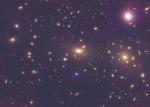 The Coma Cluster of Galaxies
6.08.2000
Almost every object in the above photograph is a galaxy. The Coma Cluster of Galaxies pictured above is one of the densest clusters known - it contains thousands of galaxies. Each of these galaxies houses billions of stars - just as our own Milky Way Galaxy
 The Coma Cluster of Galaxies
3.02.2002
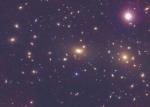
Almost every object in the above photograph is a galaxy. The Coma Cluster of Galaxies pictured above is one of the densest clusters known - it contains thousands of galaxies. Each of these galaxies houses billions of stars - just as our own Milky Way Galaxy does.
|
January February March April May June July August September October |
|||||||||||||||||||||||||||||||||||||||||||||||||