
|
You entered: Solar System
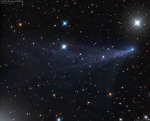 Blue Comet PanSTARRS
12.01.2018
Discovered with the PanSTARRS telescope on September 7, 2016, this Comet PanSTARRS, C/2016 R2, is presently about 24 light minutes (3 AU) from the Sun, sweeping through planet Earth's skies across the background of stars in the constellation Taurus.
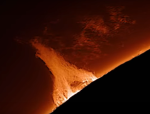 Eiffel Tower Prominence on the Sun
16.02.2022
What's that on the Sun? Although it may look like a flowing version of the Eiffel Tower, it is a solar prominence that is actually much bigger -- about the height of Jupiter.
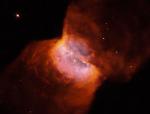 NGC 2346: A Butterfly Shaped Planetary Nebula
12.10.1999
It may look like a butterfly, but it's bigger than our Solar System. NGC 2346 is a planetary nebula made of gas and dust that has evolved into a familiar shape. At the heart of the bipolar planetary nebula is a pair of close stars orbiting each other once every sixteen days.
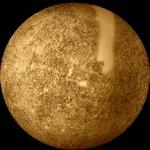 Mariner's Mercury
17.12.1996
Mercury, the closest planet to the Sun, remains the most mysterious of the Solar System's inner planets. Hiding in the Sun's glare it is a difficult target for Earth bound observers.
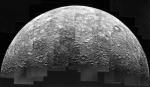 Mercury: A Cratered Inferno
12.09.2004
Mercury's surface looks similar to our Moon's. Each is heavily cratered and made of rock. Mercury's diameter is about 4800 km, while the Moon's is slightly less at about 3500 km (compared with about 12,700 km for the Earth). But Mercury is unique in many ways.
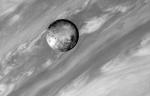 5 Million Miles From Io
11.03.1999
Twenty years ago this month, NASA's Voyager 1 spacecraft flew past Jupiter and its moons. This sharp picture of moon Io against a background of gas giant Jupiter's diffuse swirling cloud bands was recorded by Voyager's camera from a distance of about 5 million miles.
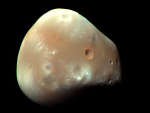 Martian Moon Deimos from MRO
16.03.2009
Mars has two tiny moons, Phobos and Deimos. Pictured above, in a recently release image by HiRISE camera onboard the Mars-orbiting Mars Reconnaissance Orbiter (MRO), is Deimos, the smaller moon of Mars. Deimos is one of the smallest known moons in the Solar System measuring only about 15 kilometers across.
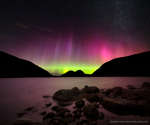 Aurora over Maine
17.09.2014
It has been a good week for auroras. Earlier this month active sunspot region 2158 rotated into view and unleashed a series of flares and plasma ejections into the Solar System during its journey across the Sun's disk.
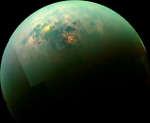 Titan Seas Reflect Sunlight
1.02.2015
Why would the surface of Titan light up with a blinding flash? The reason: a sunglint from liquid seas. Saturn's moon Titan has numerous smooth lakes of methane that, when the angle is right, reflect sunlight as if they were mirrors.
 APOD: 2023 September 3 Б Comet Schwassmann Wachmann 3 Fragments
3.09.2023
Periodic comet 73P/Schwassmann-Wachmann 3 has broken up at least twice. A cosmic souffle of ice and dust left over from the early solar system, this comet was first seen to split into several large pieces during the close-in part of its orbit in 1995.
|
January February March April May June July August |
||||||||||||||||||||||||||||||||||||||||||||||||||||||||