
|
You entered: Milky Way
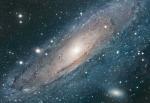 M31: The Andromeda Galaxy
21.10.2002
Andromeda is the nearest major galaxy to our own Milky Way Galaxy. Our Galaxy is thought to look much like Andromeda. Together these two galaxies dominate the Local Group of galaxies. The diffuse light from Andromeda is caused by the hundreds of billions of stars that compose it.
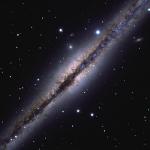 Interstellar Dust Bunnies of NGC 891
19.09.1999
What is going on in NGC 891? This galaxy appeared previously to be very similar to our own Milky Way Galaxy: a spiral galaxy seen nearly edge-on. However, recent high-resolution images of NGC 891's dust show unusual filamentary patterns extending well away from its Galactic disk.
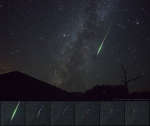 Perseid Fireball at Sunset Crater
19.08.2016
On the night of August 12, this bright Perseid meteor flashed above volcanic Sunset Crater National Monument, Arizona, USA, planet Earth. Streaking along the summer Milky Way, its initial color is likely due to the shower meteor's characteristically high speed.
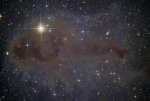 Lynds Dark Nebula
20.09.2021
Stars are forming in Lynds Dark Nebula (LDN) 1251. About 1,000 light-years away and drifting above the plane of our Milky Way galaxy, the dusty molecular cloud is part of a complex of dark nebulae mapped toward the Cepheus flare region.
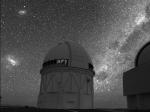 A Cerro Tololo Sky
6.08.2006
High atop a Chilean mountain lies one of the premier observatories of the southern sky: the Cerro Tololo Inter-American Observatory (CTIO). Pictured above is the dome surrounding one of the site's best known instruments, the 4-meter Blanco Telescope.
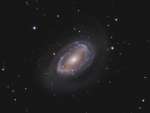 One Armed Spiral Galaxy NGC 4725
6.06.2009
While most spiral galaxies, including our own Milky Way, have two or more spiral arms, NGC 4725 seems to have only one. In this sharp color image, the solo spira mirabilis is tightly wound, traced by bluish, newborn star clusters.
 Globular Star Cluster 47 Tuc
16.01.2011
Globular star cluster 47 Tucanae is a jewel of the southern sky. Also known as NGC 104, it roams the halo of our Milky Way Galaxy along with some 200 other globular star clusters.
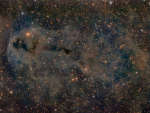 Lynds Dark Nebula 1251
30.09.2016
Stars are forming in Lynds Dark Nebula (LDN) 1251. About 1,000 light-years away, the dusty molecular cloud is part of a complex of dark nebulae mapped toward the Cepheus flare region, drifting above the plane of our Milky Way galaxy.
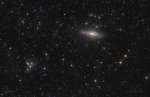 Galaxies in Pegasus
15.10.2020
This sharp telescopic view reveals galaxies scattered beyond the stars of the Milky Way, at the northern boundary of the high-flying constellation Pegasus. Prominent at the upper right is NGC 7331. A mere...
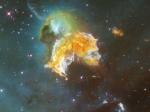 Rampaging Supernova Remnant N63A
8.06.2005
What has this supernova left behind? As little as 2,000 years ago, light from a massive stellar explosion in the Large Magellanic Clouds (LMC) first reached planet Earth. The LMC is a close...
|
January February March April May June July August September October |
|||||||||||||||||||||||||||||||||||||||||||||||||