
|
You entered: Solar System
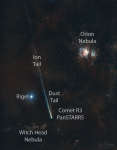 APOD: 2026 May 10 Б Comet R3 PanSTARRS and Orion
9.05.2026
Orion never had a sword like this. As Comet C/2025 R3 (PanSTARRS) heads out of the inner Solar System, it is putting on quite a show for long exposure cameras. Currently seen toward the constellation of Orion the Hunter, the distant Orion Nebula is visible on the upper right.
 APOD: 2024 May 11 Б AR 3664: Giant Sunspot Group
10.05.2024
Right now, one of the largest sunspot groups in recent history is crossing the Sun. Active Region 3664 is not only big -- it's violent, throwing off clouds of particles into the Solar System. Some of these CMEs are already impacting the Earth, and others might follow.
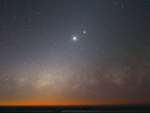 Chilean Skyscape
28.11.2008
Night skies over Chilean mountain top observatories can be dark and clear, with glorious cosmic vistas. In this recent example, the plane of our Milky Way galaxy stretches parallel to the horizon, the galactic center's star clusters, dark dust clouds, and glowing nebulae hovering in the west.
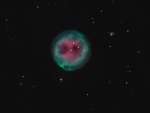 M97: The Owl Nebula
15.05.2009
The Owl Nebula is perched in the sky about 2,600 light-years away toward the bottom of the Big Dipper's bowl. Also cataloged as M97, the 97th object in Messier's well-known list, its round shape along with the placement of two large, dark "eyes" do suggest the face of a staring owl.
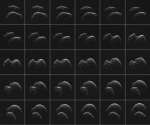 Asteroid 2014 JO25
19.04.2017
A day before its closest approach, asteroid 2014 JO25 was imaged by radar with the 70-meter antenna of NASA's Goldstone Deep Space Communications Complex in California. This grid of 30 radar images, top left to lower right, reveals the two-lobed shape of the asteroid that rotates about once every five hours.
 APOD: 2025 September 8 Б IRAS 04302: Butterfly Disk Planet Formation
7.09.2025
This butterfly can hatch planets. The nebula fanning out from the star IRAS 04302+2247 may look like the wings of a butterfly, while the vertical brown stripe down the center may look like the butterfly's body -- but together they indicate an active planet-forming system.
 APOD: 2026 April 21 Б Three Sky Arches over Snowy Alps
20.04.2026
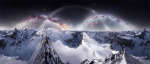
Why are there three arches across the sky instead of two? Last month, after being dropped off by a helicopter at a high mountain peak in the Alps near the Swiss Italian border, an adventurous astrophotographer expected two arches of our Milky Way galaxy to be visible during the night.
 A Long Snaking Filament on the Sun
12.09.2022
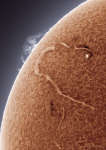
Earlier this month, the Sun exhibited one of the longer filaments on record. Visible as the bright curving streak around the image center, the snaking filament's full extent was estimated to be over half of the Sun's radius -- more than 350,000 kilometers long.
 Young Star, Dark Cloud
25.12.2003
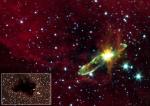
High-speed outflows of molecular gas from a young stellar object glow in infrared light, revealing themselves in this recent false-color image from the Spitzer Space Telescope. Cataloged as HH (Herbig-Haro) 46/47 the infrared source...
 The Cracked Ice Plains of Europa
22.10.1996
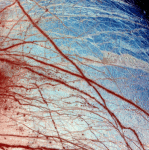
What caused the cracks in this giant ice-ball? Jupiter's moon Europa has smoothest surface in the solar system and is composed mostly of cracked water-ice. In the above false-colored picture released last week...
|
January February March April May June July August |
||||||||||||||||||||||||||||||||||||||||||||||||||||||||