
|
You entered: composite image
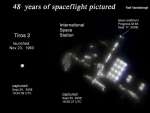 48 Years of Space Flight
16.10.2008
This year, NASA celebrated its 50th anniversary. Inspired to make his own contribution, astronomer Ralf Vandebergh set out to record images of some historic spacecraft in Earth orbit -- captured with his own modest equipment and a hand-guided, 10-inch, Newtonian reflecting telescope. One result is this intriguing composite effectively spanning 48 years of space flight!
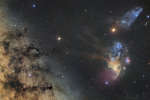 Saturn and Mars visit Milky Way Star Clouds
9.05.2016
Planets, stars, nebulas and a galaxy -- this impressive image has them all. Closest to home are the two planets Mars (right) and Saturn (center), visible as the two bright orange spots in the upper half of the featured image.
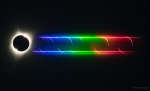 The Flash Spectrum of the Sun
6.09.2017
In clear Madras, Oregon skies, this colorful eclipse composite captured the elusive chromospheric or flash spectrum of the Sun. Only three exposures, made on August 21 with telephoto lens and diffraction grating, are aligned in the frame.
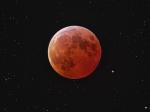 Eclipsed Moon and Stars
7.03.2007
This dramatic image features a dark red Moon during a total lunar eclipse -- celestial shadow play enjoyed by many denizens of planet Earth last Saturday. Recorded near Wildon, Austria, the picture is a composite...
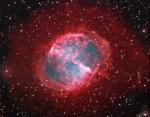 Dumbbell Nebula Halo
25.07.2003
In 1764, French astronomer Charles Messier sighted this gorgeous cosmic cloud which he described as an oval nebula without stars. Cataloged as M27, it is now popularly known as the Dumbbell Nebula...
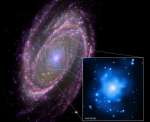 M81: Feeding a Black Hole
27.06.2008
This impressive color composite shows spiral galaxy M81 across the electromagnetic spectrum. It combines X-ray data (blue) from the Chandra Observatory, infrared data (pink) from the Spitzer Space Telescope, and an ultraviolet image (purple) from the GALEX satellite, with a visible light (green) Hubble image.
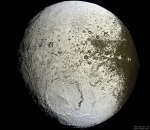 Saturns Iapetus: Painted Moon
2.06.2018
What has happened to Saturn's moon Iapetus? Vast sections of this strange world are dark as coal, while others are as bright as ice. The composition of the dark material is unknown, but infrared spectra indicate that it possibly contains some dark form of carbon.
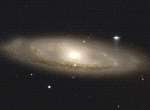 M65 Without Moth
7.08.1998
Messier 65 (M65) is a bright spiral galaxy of stars only 35 million light-years away in the constellation Leo. With very tightly wound spiral arms, a large central bulge, and well defined dust lanes, this galaxy is a member of a group of galaxies known as the Leo triplet.
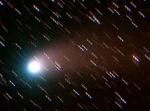 Comet McNaught Hartley
13.03.2001
Outbound and climbing above the plane of our solar system, comet McNaught-Hartley (C/1999 T1) is presently soaring through northern skies. This telescopic picture, a composite of many 30 second exposures made through three color filters, recorded the delicate colors in its diminutive coma and faint tail on February 26th.
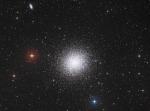 M13: The Great Globular Cluster in Hercules
14.11.2007
M13 is modestly recognized as the Great Globular Cluster in Hercules. A system of stars numbering in the hundreds of thousands, it is one of the brightest globular star clusters in the northern sky.
|
January February March April May June July August |
||||||||||||||||||||||||||||||||||||||||||||||||||||||||