
|
You entered: emission
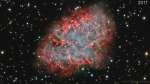 M1: The Incredible Expanding Crab Nebula
19.01.2020
Are your eyes good enough to see the Crab Nebula expand? The Crab Nebula is cataloged as M1, the first on Charles Messier's famous list of things which are not comets. In fact...
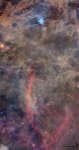 From the Pleiades to the Eridanus Loop
23.03.2020
If you stare at an interesting patch of sky long enough, will it look different? In the case of Pleiades and Hyades star clusters -- and surrounding regions -- the answer is: yes, pretty different. Long...
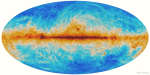 Magnetic Streamlines of the Milky Way
17.06.2020
What role do magnetic fields play in interstellar physics? Analyses of observations by ESA's Planck satellite of emission by small magnetically-aligned dust grains reveal previously unknown magnetic field structures in our Milky Way Galaxy -- as shown by the curvy lines in the featured full-sky image.
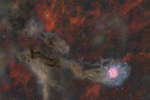 APOD: 2026 September 21 Б Cocoon Nebula Wide Field
21.09.2026
When does a nebula look like a comet? In this crowded starfield covering over two degrees within the high-flying constellation of the Swan (Cygnus), the eye is drawn to the Cocoon Nebula. A compact...
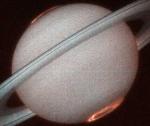 Saturnian Aurora
17.09.2000
Girdling the second largest planet in the Solar System, Saturn's Rings are one of the most spectacular sights for earthbound telescopes. This image from the orbiting Hubble Space Telescope's STIS instrument, offers a striking view of another kind of ring around Saturn - pole encircling rings of ultraviolet aurora.
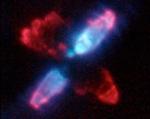 Shells in the Egg Nebula
26.06.1999
The Egg Nebula is taking a beating. Like a baby chick pecking its way out of an egg, the star in the center of the Egg Nebula is casting away shells of gas and dust as it slowly transforms itself into a white dwarf star.
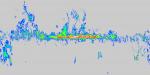 Milky Way Molecule Map
30.04.1997
Where are the Milky Way's gas clouds and where are they going? Stars form in gas clouds, and the motion of gas clouds tell us about the size and rotation speed of our own Milky Way Galaxy.
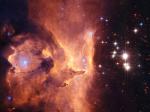 Massive Stars in Open Cluster Pismis 24
19.12.2006
How massive can a normal star be? Estimates made from distance, brightness and standard solar models had given one star in the open cluster Pismis 24 over 200 times the mass of our Sun, making it a record holder.
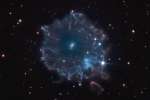 Halo of the Cat s Eye
31.08.2012
The Cat's Eye Nebula (NGC 6543) is one of the best known planetary nebulae in the sky. Its haunting symmetries are seen in the very central region of this tantalizing image, processed to reveal the enormous but extremely faint halo of gaseous material, about 6 light-years across, which surrounds the brighter, familiar planetary nebula.
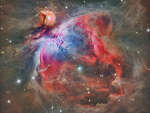 M42: Inside the Orion Nebula
20.03.2013
The Great Nebula in Orion, an immense, nearby starbirth region, is probably the most famous of all astronomical nebulas. Here, glowing gas surrounds hot young stars at the edge of an immense interstellar molecular cloud only 1500 light-years away.
|
January February March April May June July August September |
|||||||||||||||||||||||||||||||||||||||||||||||||