
|
You entered: nearest stars
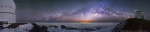 Mauna Kea Milky Way Panorama
19.02.2009
Aloha and welcome to a breathtaking skyscape. The dreamlike panoramic view looks out from the 4,200 meter volcanic summit of Mauna Kea, Hawai'i, across a layer of clouds toward a starry night sky and the rising Milky Way.
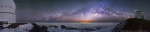 Milky Way Panorama from Mauna Kea
10.03.2013
Aloha and welcome to a breathtaking skyscape. The dreamlike panoramic view looks out from the 4,200 meter volcanic summit of Mauna Kea, Hawai'i, across a layer of clouds toward a starry night sky and the rising Milky Way.
 Aurora Australis and the International Space Station
13.09.2024
This snapshot from the International Space Station was taken on August 11 while orbiting about 430 kilometers above the Indian Ocean, Southern Hemisphere, planet Earth. The spectacular view looks south and east, down toward the planet's horizon and through red and green curtains of aurora australis.
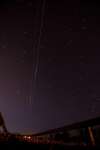 Dawn s Endeavour
27.02.2010
On February 21st, the Space Shuttle Endeavour and the International Space Station (ISS) flew through the sky near dawn over Whitby, Ontario, Canada. Along with star trails, both were captured in this single time exposure. Glinting in sunlight 350 kilometers above the Earth, Endeavour slightly preceeded the ISS arcing over the horizon.
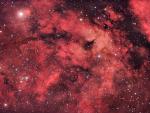 A Cygnus Star Field
28.07.2004
In the constellation of the swan near the nebula of the pelican lies the gas cloud of the butterfly surrounding a star known as the hen. That star, given the proper name Sadr, is visible to the unaided eye but found here as the brightest object on the upper left.
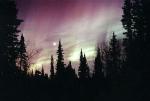 Aurora Through a Moonlit Sky
2.11.1999
A night sky can glow in fascinating ways. Through a clearing in the woods, the pictured sky above Alaska shines by reflected light from a nearby city, by the brightness of the Moon, and by aurora.
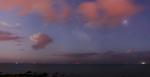 Constellations and Cloudy Skies
11.07.2007
Recorded earlier in July, the clouds of planet Earth reflect moonlight and a faint, reddish glow in this serene sea and skyscape. Beyond them lie the cosmic dust and star clouds of the Milky Way.
 Betelgeuse Eclipsed
15.12.2023
Asteroid 319 Leona cast a shadow across planet Earth on December 12, as it passed in front of bright star Betelgeuse. But to see everyone's favorite red giant star fade this time...
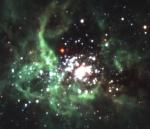 Tarantula
4.06.1997
NGC 2070 is an immense star forming region in a nearby galaxy known as the Large Magellanic Cloud. Its spidery appearance is responsible for its popular name, "The Tarantula Nebula", except that this tarantula is about 1,000 light-years across, and 165,000 light-years away in the southern constellation Dorado.
 Mars Saturn Conjunction
9.04.2022
Fainter stars in the zodiacal constellation Capricornus are scattered near the plane of the ecliptic in this field of view. The two brightest ones at center aren't stars at all though, but the planets Mars and Saturn.
|
January February March April May June July August September |
|||||||||||||||||||||||||||||||||||||||||||||||||