
|
You entered: wind
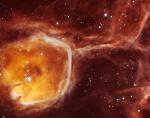 Windblown N44F
19.08.2004
A fast and powerful wind from a hot young star has created this stunning bubble-shaped nebula poised on the end of a bright filament of hydrogen gas. Cataloged as N44F, the cosmic windblown bubble is seen at the left of this Hubble Space Telescope image.
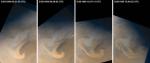 Mars Weather Watch
16.08.1999
Mars may be a cold, dry planet but its weather is dynamic. On June 30, wide angle cameras on board the Mars Global Surveyor (MGS) spacecraft watched the development of this large scale storm system above Mars' north polar area.
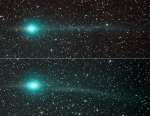 Comet Lulin Tails
7.02.2009
Sweeping through the inner solar system, Comet Lulin is easily visible in both northern and southern hemispheres with binoculars or a small telescope. Recent changes in Lulin's lovely greenish coma and tails are featured in this two panel comparison of images taken on January 31st (top) and February 4th.
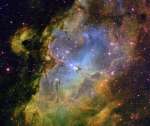 The Eagle Nebula from Kitt Peak
16.04.2012
From afar, the whole thing looks like an Eagle. A closer look at the Eagle Nebula, however, shows the bright region is actually a window into the center of a larger dark shell of dust. Through this window, a brightly-lit workshop appears where a whole open cluster of stars is being formed.
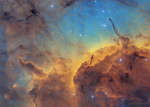 Stars, Dust, Pillars, and Jets in the Pelican Nebula
11.10.2022
What dark structures arise within the Pelican Nebula? On the whole, the nebula appears like a bird (a pelican) and is seen toward the constellation of a different bird: Cygnus, a Swan. But inside, the Pelican Nebula is a place lit up by new stars and befouled by dark dust.
 APOD: 2023 April 24 Б The Medulla Nebula Supernova Remnant
24.04.2023
What powers this unusual nebula? CTB-1 is the expanding gas shell that was left when a massive star toward the constellation of Cassiopeia exploded about 10,000 years ago. The star likely detonated when it ran out of elements near its core that could create stabilizing pressure with nuclear fusion.
 APOD: 2024 January 9 Б Thors Helmet
9.01.2024
Thor not only has his own day (Thursday), but a helmet in the heavens. Popularly called Thor's Helmet, NGC 2359 is a hat-shaped cosmic cloud with wing-like appendages. Heroically sized even for a Norse god, Thor's Helmet is about 30 light-years across.
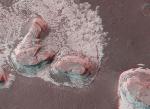 3D Mars: Northern Terra Meridiani
28.08.2002
In this spectacular 3D stereoscopic view from orbit, steep-sided, flat-topped hills stand above the Terra Meridiani region of Mars. Seen best with red/blue glasses (red for the left eye), the structures are reminiscent of buttes and mesas found in southwestern areas of the North American continent on planet Earth.
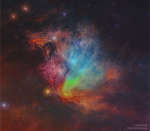 Seven Dusty Sisters
28.05.2018
Is this really the famous Pleaides star cluster? Known for its iconic blue stars, the Pleaides is shown here in infrared light where the surrounding dust outshines the stars. Here three infrared colors have been mapped into visual colors (R=24, G=12, B=4.6 microns).
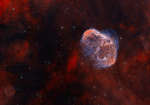 Cygnus: Bubble and Crescent
17.10.2020
These clouds of gas and dust drift through rich star fields along the plane of our Milky Way Galaxy toward the high flying constellation Cygnus. Caught within the telescopic field of view are the Soap Bubble (lower left) and the Crescent Nebula (upper right).
|
January February March April May June July August September October |
|||||||||||||||||||||||||||||||||||||||||||||||||