
|
You entered: Earth orbit
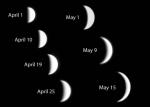 Phases of Venus
21.05.2004
Venus is currently falling out of the western evening sky. Second planet from the Sun and third brightest celestial object after the Sun and Moon, Venus has been appreciated by casual sky gazers as a brilliant beacon above the horizon after sunset. But telescopic images have also revealed its dramatic phases.
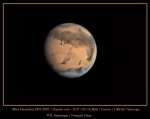 Mars in View
6.12.2007
Very good telescopic views of Mars can be expected in the coming weeks as the Red Planet nears opposition on December 24th. Of course, opposition means opposite the Sun in planet Earth's sky - an arrangement that occurs every 26 months for Mars.
 APOD: 2024 June 2 Б Rotating Moon from LRO
2.06.2024
No one, presently, sees the Moon rotate like this. That's because the Earth's moon is tidally locked to the Earth, showing us only one side. Given modern digital technology, however, combined with many detailed images returned by the Lunar Reconnaissance Orbiter (LRO), a high resolution virtual Moon rotation movie has been composed.
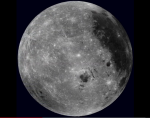 Rotating Moon from LRO
19.07.2020
No one, presently, sees the Moon rotate like this. That's because the Earth's moon is tidally locked to the Earth, showing us only one side. Given modern digital technology, however, combined with many detailed images returned by the Lunar Reconnaissance Orbiter (LRO), a high resolution virtual Moon rotation movie has been composed.
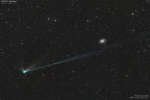 APOD: 2026 February 17 Б Tails of Comet Wierzchoе
17.02.2026
Some comets are regular guests of our solar neighborhood; others come by only once, never to return. We wonБt have another chance to see Comet C/2024 E1 (Wierzchoе), which is currently making its way through the inner Solar System. The hyperbolic orbit of this comet indicates that it will likely become an interstellar traveler.
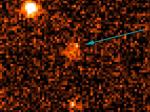 GRB Fireball Persists
17.09.1997
It's still there. The optical counterpart to the instantly famous gamma-ray burst (GRB) that occurred last February 28th has faded - but not completely. The astronomical community had waited patiently for months...
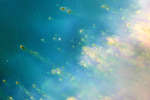 Curious Cometary Knots in the Helix Nebula
13.04.2008
What causes unusual knots of gas and dust in planetary nebulas? Seen also in the Ring Nebula, the Dumbbell Nebula and the Eskimo Nebula, the knots' existence was not initially predicted and their origins are still not well understood.
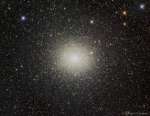 Omega Centauri: The Brightest Globular Star Cluster
27.04.2016
This huge ball of stars predates our Sun. Long before humankind evolved, before dinosaurs roamed, and even before our Earth existed, ancient globs of stars condensed and orbited a young Milky Way Galaxy. Of the 200 or so globular clusters that survive today, Omega Centauri is the largest, containing over ten million stars.
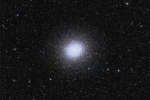 Omega Centauri: The Largest Globular Cluster Known
1.03.2009
This huge ball of stars predates our Sun. Long before humankind evolved, before dinosaurs roamed, and even before our Earth existed, ancient globs of stars condensed and orbited a young Milky Way Galaxy. Of the 200 or so globular clusters that survive today, Omega Centauri is the largest, containing over ten million stars.
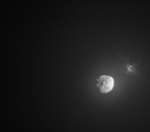 DART Asteroid Impact from Space
29.09.2022
Fifteen days before impact, the DART spacecraft deployed a small companion satellite to document its historic planetary defense technology demonstration. Provided by the Italian Space Agency, the Light Italian CubeSat for Imaging Asteroids, aka LICIACube, recorded this image of the event's aftermath.
|
January February March April May June July August September October |
|||||||||||||||||||||||||||||||||||||||||||||||||