
|
You entered: hot star
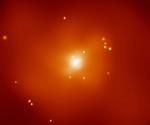 Dark Matter, X rays, and NGC 720
26.10.2002
Elliptical galaxy NGC 720 is enveloped in a cosmic cloud of x-ray emitting gas. Seen in this false color image from the Chandra X-ray Observatory, the extreme temperature of the gas - about 7 million...
 Supernova Remnant Cassiopeia A
14.12.2023
Massive stars in our Milky Way Galaxy live spectacular lives. Collapsing from vast cosmic clouds, their nuclear furnaces ignite and create heavy elements in their cores. After only a few million years for the most massive stars, the enriched material is blasted back into interstellar space where star formation can begin anew.
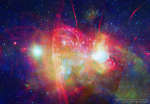 The Galactic Center from Radio to X ray
31.03.2020
In how many ways does the center of our Galaxy glow? This enigmatic region, about 26,000 light years away toward the constellation of the Archer (Sagittarius), glows in every type of light that we can see.
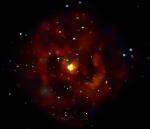 X Rays from M83
6.02.2003
Bright and beautiful spiral galaxy M83 lies a mere twelve million light-years from Earth, toward the headstrong constellation Hydra. Sweeping spiral arms, prominent in visible light images, lend this galaxy its popular moniker -- the Southern Pinwheel.
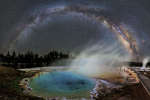 APOD: 2026 August 16 Б Milky Way over Yellowstone
16.08.2026
The Milky Way was not created by an evaporating lake. The colorful pool of water, about 10 meters across, is known as Silex Spring and is located in Yellowstone National Park in Wyoming, USA. Illuminated artificially, the colors are caused by layers of bacteria that grow in the hot spring.
 APOD: 2025 October 10 Б 50 Light-years to 51 Pegasi
10.10.2025
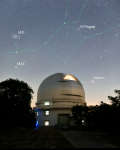
It's only 50 light-years to 51 Pegasi. That star's position is indicated in this snapshot from August 2025, taken on a night with mostly brighter stars visible above the dome at Observatoire de Haute-Provence in France.
 NGC 253: X Ray Zoom
7.06.2001
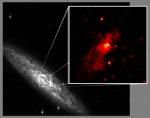
Astronomers now report that Chandra X-ray Observatory observations of galaxies known to be frantically forming stars show that these galaxies also contain luminous x-ray sources -- thought to be intermediate mass black holes and immense clouds of superheated gas. Take the lovely island universe NGC 253 for example.
 A Volcano of Fire under a Milky Way of Stars
27.05.2019
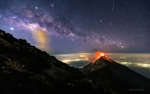
Sometimes it's hard to decide which is more impressive -- the land or the sky. On the land of the featured image, for example, the Volcano of Fire (VolcАn de Fuego) is seen erupting topped by red-hot, wind-blown ash and with streams of glowing lava running down its side.
 The Colors and Mysteries of Centaurus A
12.08.2002
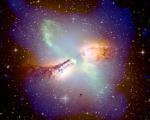
Why is spiral galaxy Centaurus A in so much turmoil? The above composite image shows different clues to the unusual galaxy's past in different bands of light. In low energy radio waves, shown in red, lobes across the thick swath of dust glow brightly.
 A Dangerous Summer on HD 80606b
4.02.2009
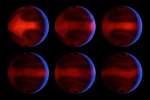
On the distant planet HD 80606b, summers might be dangerous. Hypothetic life forms floating in HD 080606b's atmosphere or lurking on one of its (presently hypothetical) moons might fear the 1,500 Kelvin summer heat, which is hot enough not only to melt lead but also nickel.
|
January February March April May June July August |
||||||||||||||||||||||||||||||||||||||||||||||||||||||||