
|
You entered: nebula
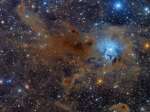 NGC 7023: The Iris Nebula
6.05.2016
These cosmic clouds have blossomed 1,300 light-years away, in the fertile starfields of the constellation Cepheus. Called the Iris Nebula, NGC 7023 is not the only nebula to evoke the imagery of flowers, though.
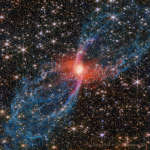 APOD: 2026 February 3 Б Red Spider Planetary Nebula from Webb
3.02.2026
Oh what a tangled web a planetary nebula can weave. The Red Spider Planetary Nebula shows the complex structure that can result when a normal star ejects its outer gases and becomes a white dwarf star.
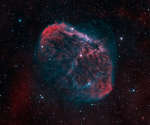 NGC 6888: The Crescent Nebula
10.06.2016
NGC 6888, also known as the Crescent Nebula, is a cosmic bubble about 25 light-years across, blown by winds from its central, bright, massive star. This sharp telescopic portrait uses narrow band image data that isolates light from hydrogen and oxygen atoms in the wind-blown nebula.
 Cone Nebula Infrared Close Up
6.06.2002
After astronauts repaired NICMOS - the Near Infrared Camera and Multi-Object Spectrometer - during the latest Hubble Space Telescope servicing mission, astronomers were quick to turn the sophisticated instrument on the photogenic stellar nursery known as the Cone Nebula.
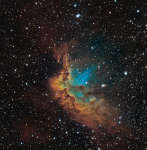 The Wizard Nebula
29.08.2014
Open star cluster NGC 7380 is still embedded in its natal cloud of interstellar gas and dust popularly known as the Wizard Nebula. Seen with foreground and background stars along the plane of our Milky Way galaxy it lies some 8,000 light-years distant, toward the constellation Cepheus.
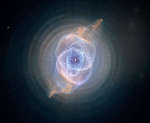 The Cat's Eye Nebula from Hubble
8.11.2014
To some, it may look like a cat's eye. The alluring Cat's Eye nebula, however, lies three thousand light-years from Earth across interstellar space. A classic planetary nebula, the Cat's Eye (NGC 6543) represents a final, brief yet glorious phase in the life of a sun-like star.
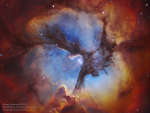 In the Center of the Trifid Nebula
1.11.2020
What's happening at the center of the Trifid Nebula? Three prominent dust lanes that give the Trifid its name all come together. Mountains of opaque dust appear near the bottom, while other dark filaments of dust are visible threaded throughout the nebula.
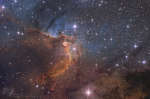 SH2 155: The Cave Nebula
5.11.2014
This colorful skyscape features the dusty Sharpless catalog emission region Sh2-155, the Cave Nebula. In the composite image, data taken through narrowband filters tracks the glow of ionized sulfur, hydrogen, and oxygen atoms in red, green, and blue hues.
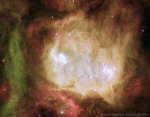 Halloween and the Ghost Head Nebula
24.10.2021
Halloween's origin is ancient and astronomical. Since the fifth century BC, Halloween has been celebrated as a cross-quarter day, a day halfway between an equinox (equal day / equal night) and a solstice (minimum day / maximum night in the northern hemisphere).
 Planetary Nebula Project
18.02.2011
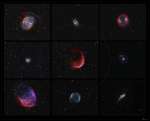
Cast off by dying sunlike stars, planetary nebulae are a brief but glorious final phase of stellar evolution. The gaseous shrouds are ionized by an extremely hot central source, the shrinking core of a star running out of fuel for nuclear fusion.
|
January February March April May June July August |
||||||||||||||||||||||||||||||||||||||||||||||||||||||||