
|
You entered: Milky Way
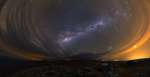 Atacama s Cloudy Night
27.07.2013
Storm clouds do sometimes come to Chile's Atacama desert, known as the driest place on Earth. These washed through the night sky just last month during the winter season, captured in this panoramic view.
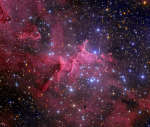 Melotte 15 in the Heart
27.12.2013
Cosmic clouds seem to form fantastic shapes in the central regions of emission nebula IC 1805. Of course, the clouds are sculpted by stellar winds and radiation from massive hot stars in the nebula's newborn star cluster, Melotte 15.
 M100: A Grand Design Spiral Galaxy
24.12.2018
Majestic on a truly cosmic scale, M100 is appropriately known as a grand design spiral galaxy. It is a large galaxy of over 100 billion stars with well-defined spiral arms that is similar to our own Milky Way Galaxy.
 Star Factory Messier 17
7.09.2023
Sculpted by stellar winds and radiation, the star factory known as Messier 17 lies some 5,500 light-years away in the nebula-rich constellation Sagittarius. At that distance, this 1/3 degree wide field of view spans over 30 light-years.
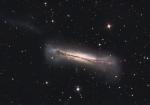 Sideways Galaxy NGC 3628
8.04.2005
Dark dust lanes cutting across the middle of this gorgeous island universe strongly hint that NGC 3628 is a spiral galaxy seen sideways. About 35 million light-years away in the northern springtime constellation...
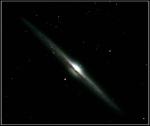 NGC 4565: Needle Galaxy
17.06.1999
Presenting a sleek needle-like profile the magnificent spiral galaxy NGC 4565 is viewed edge-on from planet Earth. Its core of stars bulges from the centre of a thin disk of spiral arms and dust. The core appears to be cut sharply by dust lanes to dramatic effect in this composite image.
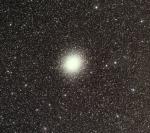 Omega Centauri
26.05.2006
Centaurus, the Centaur, is one of the most striking constellations in the southern sky. The Milky Way flows through this celestial expanse whose wonders also include the closest star to the sun, Alpha Centauri, and the largest globular star cluster in our galaxy, Omega Centauri.
 Gemini South Star Trails
1.09.2006
Stars seem to arc through southern skies in this surrealistic time exposure -- recorded before moonrise from the Gemini South Observatory, Cerro Pachon, Chile, Planet Earth. During the one hour 40 minute exposure camera and tripod were fixed, so the concentric star trails are a reflection of Earth's daily rotation about its axis.
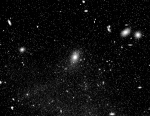 The Virgo Cluster of Galaxies
19.02.2000
Pictured are several galaxies of the Virgo Cluster, the closest cluster of galaxies to our Milky Way Galaxy. The Virgo Cluster spans more than 5 degrees on the sky - about 10 times the angle made by a full Moon. It contains over 100 galaxies of many types - including spirals, ellipticals, and irregular galaxies.
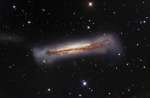 Sideways Galaxy NGC 3628
15.05.2008
Dark dust lanes cut across the middle of this gorgeous island universe, a strong hint that NGC 3628 is a spiral galaxy seen sideways. About 35 million light-years away in the northern springtime constellation...
|
January February March April May June July August September October |
|||||||||||||||||||||||||||||||||||||||||||||||||