
|
You entered: rings
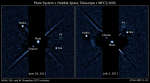 Pluto s P4
22.07.2011
Nix and Hydra were first introduced to human eyes in Hubble Space Telescope images from May 2005, as Pluto's second and third known moons. Now Hubble images have revealed a fourth satellite for the icy, dwarf planet. Provisionally designated P4, it completes an orbit of Pluto in about 31 days.
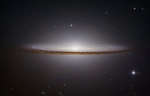 Messier 104
23.04.2022
A gorgeous spiral galaxy, Messier 104 is famous for its nearly edge-on profile featuring a broad ring of obscuring dust lanes. Seen in silhouette against an extensive central bulge of stars, the swath of cosmic dust lends a broad brimmed hat-like appearance to the galaxy suggesting a more popular moniker, the Sombrero Galaxy.
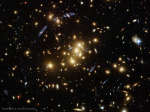 Giant Cluster Bends Breaks Images
23.08.2015
What are those strange blue objects? Many of the brightest blue images are of a single, unusual, beaded, blue, ring-like galaxy which just happens to line-up behind a giant cluster of galaxies. Cluster galaxies here typically appear yellow and -- together with the cluster's dark matter -- act as a gravitational lens.
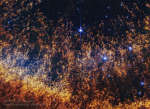 APOD: 2026 August 4 Б Curious Cometary Knots in the Helix Nebula
4.08.2026
What causes unusual knots of gas and dust in planetary nebulas? Seen also in the Ring Nebula, the Dumbbell Nebula and NGC 2392, the knots' existence was not initially predicted, and their origins are still not well understood.
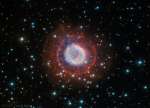 Planetary Nebula NGC 2438
7.04.2011
NGC 2438 is a planetary nebula, the gaseous shroud cast off by a dying sunlike star billions of years old whose central reservoir of hydrogen fuel has been exhausted. About 3,000 light-years distant it lies within the boundaries of the nautical constellation Puppis.
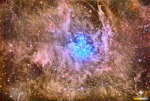 The Pleiades Deep and Dusty
14.11.2017
The well-known Pleiades star cluster is slowly destroying part of a passing cloud of gas and dust. The Pleiades is the brightest open cluster of stars on Earth's sky and can be seen from almost any northerly location with the unaided eye.
 Welcome to the International Year of Astronomy
1.01.2009
Astronomers all over planet Earth invite you to experience the night sky as part of the International Year of Astronomy 2009. This year was picked by the International Astronomical Union and the United Nations Educational, Scientific, and Cultural Organization because it occurs 400 years after Galileo turned one of the first telescopes toward the heavens.
 APOD: 2023 May 16 Б Total Eclipse: The Big Corona
16.05.2023
Most photographs don't adequately portray the magnificence of the Sun's corona. Seeing the corona first-hand during a total solar eclipse is unparalleled. The human eye can adapt to see coronal features and extent that average cameras usually cannot. Welcome, however, to the digital age.
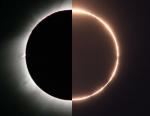 Hybrid Solar Eclipse
6.05.2005
April's spectacular geocentric celestial event was a rare hybrid eclipse of the Sun - a total or an annular eclipse could be seen depending on the observer's location. For Fred Espenak, aboard...
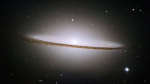 The Sombrero Galaxy from Hubble
15.05.2011
What's going on in the center of this spiral galaxy? Named the Sombrero Galaxy for its hat-like resemblance, M104 features a prominent dust lane and a bright halo of stars and globular clusters.
|
January February March April May June July August September October |
|||||||||||||||||||||||||||||||||||||||||||||||||