
|
You entered: time
 HR 4796A: A Recipe for Planets
22.04.1998
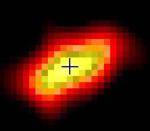
Two hundred and twenty light years from Earth, planets are forming. Recent observations of the binary star system HR 4796 have shown that one of the stars is surrounded by a dusty gaseous disk. This disk is of the right size, age, and density for dust pellets to accrete surrounding matter.
 Aurora Astern
26.10.1995
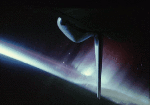
Sailing upside down, 115 nautical miles above Earth, the crew of the Space Shuttle Endeavour made this spectacular time exposure of the southern aurora (aurora australis) in October of 1994. The aurora, also known...
 Near Comet Hyakutake's Nucleus
21.03.1996
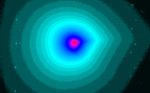
This March 19th false-color picture of Comet Hyakutake from one of the most sophisticated ground based telescopes captures the area surrounding the comet's nucleus. A comet's nucleus - not directly visible here - is a solid dirty iceball probably no more than 10 kilometers across.
 The Water Vapor Channel
12.10.1996
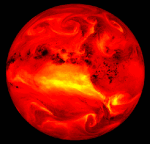
What alien planet's bizarre landscape lurks below these fiery-looking clouds? It's only Planet Earth, of course -- as seen on the Water Vapor Channel. Hourly, images like this one (shown in false color) are brought to you by the orbiting GOES 8 satellite's multi-channel imager.
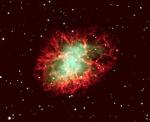 M1: Filaments of the Crab Nebula
7.02.1997
The Crab Nebula is filled with mysterious filaments. The Crab Nebula is the result of a star that exploded in 1054 AD. This spectacular supernova explosion was recorded by Chinese and (quite probably) Anasazi Indian astronomers.
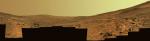 McCool Hill on Mars
15.03.2006
You can make it. Winter is rapidly advancing on the southern hemisphere on Mars, and the lack of sunlight could be dangerous unless you find a good place to hibernate. There it is ahead: McCool Hill.
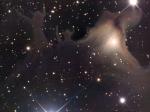 SH2 136: A Spooky Nebula
31.10.2006
The dark nebula SH2-136 appears to be celebrating Halloween all of the time. The complex process of star formation create dust clouds of many shapes and sizes -- it is human perception that might identify a ghoulish creature, on the right of the above image, chasing humans.
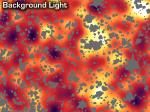 Light from the First Stars
2.01.2007
What were the first stars like? No one is yet sure. Our Sun is not a first-generation star. It is not even second generation. The first stars to appear in the universe likely came and went about 13 billion years ago.
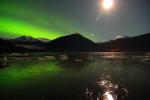 Aurora in the Distance
19.11.2007
Some auroras can only be seen with a camera. They are called sub-visual and are too faint to be seen with the unaided eye. The reason is that the human eye only accumulates light for a fraction of a second at a time, while a camera shutter can be left open indefinitely.
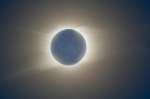 The Crown of the Sun
8.08.2008
During a total solar eclipse, the Sun's extensive outer atmosphere, or corona, is an inspirational sight. The subtle shades and shimmering features of the corona that engage the eye span a brightness range of over 10,000 to 1, making them notoriously difficult to capture in a single picture.
|
January February March April May June July August |
||||||||||||||||||||||||||||||||||||||||||||||||||||||||