
|
You entered: unusual
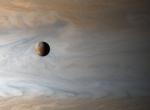 Io: Moon Over Jupiter
20.04.2001
How big is the Jovian moon Io? The most volcanic body in the Solar System, Io (usually pronounced "EYE-oh") is 3,600 kilometers in diameter, about the size of planet Earth's single large natural satellite.
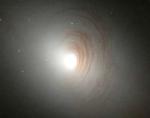 NGC 2787: A Barred Lenticular Galaxy
8.04.2002
Lenticular galaxies aren't supposed to be photogenic. Like spiral galaxies, they contain a disk, but like elliptical galaxies, they are usually short on dust, gas, and pretty spiral arms. Lenticulars are relatively little studied, possibly because of their seemingly benign nature. Famous galaxies historically classified as lenticular include M84, M85, and M86.
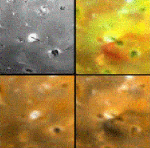 Volcano Euboea Fluctus On Io
8.09.1996
Jupiter's moon Io is turning out to be our Solar System's geologic powerhouse. The churning moon was photographed again just recently on June 27th and again shows signs of violent activity. Shown above are photographs of the volcano Euboea Fluctus taken at different times.
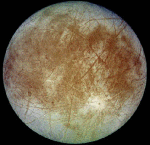 Europa Full Face
20.11.1996
What mysteries might be solved by peering into this crystal ball? This crystal ball is quite unusual because it is actually a moon of Jupiter, the crystals are ice-crystals, and the ball is not only dirty and opaque but cracked beyond repair.
 A Tornado on Planet Earth
22.07.2003
Large storms on Earth can spawn unusual, small, violent clouds known as tornadoes. Tornado clouds swirl as fast as hundreds of kilometers per second and, when they touch down, can destroy nearly everything in their long, narrow path. Many tornadoes last only a few minutes, but the largest and most dangerous can endure for hours.
 Palomar at Night
7.08.2003
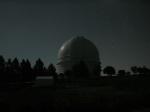
What's wrong with this picture? The summer night sky is clear, and moonlight illuminates the dome of the Hale 200-inch Telescope at Palomar Observatory, northeast of San Diego, California, USA. The familiar stars of the Teapot asterism in the constellation Sagittarius shine above the dome and to the right.
 Jupiter's Ring Halo
7.08.1997
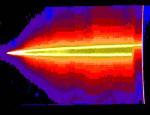
Why do small particles hover around Jupiter's rings? These particles form a previously unknown ring halo, recently discovered by the robot spacecraft Galileo currently orbiting Jupiter. Galileo obtained this image when on the far side of Jupiter - from this orientation scattered sunlight makes the halo ring visible.
 The Sombrero Galaxy from HST
8.10.2003
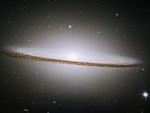
Why does the Sombrero Galaxy look like a hat? Reasons include the Sombrero's unusually large and extended central bulge of stars, and dark prominent dust lanes that appear in a disk that we see nearly edge-on. Billions of old stars cause the diffuse glow of the extended central bulge.
 A Manhattan Sunset
28.05.2004
Today, if it is clear, Manhattan will flood dramatically with sunlight just as the Sun sets precisely on the centerline of every street. Usually, the tall buildings that line the gridded streets of New York City's tallest borough will hide the setting Sun.
 The Anthe Arc around Saturn
10.09.2008
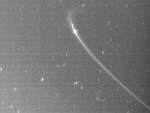
What created this unusual partial ring around Saturn? Discovered last year, the arc was captured in clear detail only two months ago by the Saturn-orbiting Cassini spacecraft. Since the arc occupies the same orbit...
|
January February March April May June July August |
||||||||||||||||||||||||||||||||||||||||||||||||||||||||