
|
You entered: Earth orbit
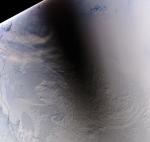 The Long Shadow of the Moon
27.11.2003
The long shadow of the Moon fell across the continent of Antarctica on November 23rd, during the second total solar eclipse of 2003. In this view from orbit, based on data from the MODIS instrument on board the Earth observing Aqua satellite, the Moon's shadow stretches for almost 500 kilometers.
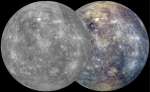 MESSENGER s First Day
8.10.2011
One solar day on a planet is the length of time from noon to noon. A solar day lasts 24 hours on planet Earth. On Mercury a solar day is about 176 Earth days long.
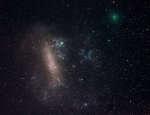 Close Comet and Large Magellanic Cloud
17.03.2016
Sporting a surprisingly bright, lovely green coma Comet 252P/Linear poses next to the Large Magellanic Cloud in this southern skyscape. The stack of telephoto exposures was captured on March 16 from Penwortham, South Australia.
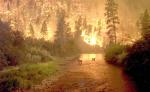 Fire on Earth
21.11.2000
Sometimes, regions of planet Earth can be seen lit up with fire. Since fire is the rapid acquisition of oxygen, and since oxygen is a key indicator of life, fire on any planet would be an indicator of life on that planet.
 MESSENGER at Mercury
31.03.2011
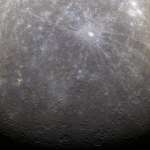
On March 17, the MESSENGER spacecraft became the first to orbit Mercury, the solar system's innermost planet. This is its first processed color image since entering Mercury orbit. Larger, denser, and with almost twice the surface gravity of Earth's moon, Mercury still looks moon-like at first glance.
 Mars Red and Spica Blue
2.04.2014
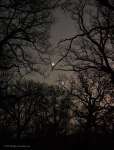
A bright pair of sky objects will be visible together during the next few months. Mars will shine brightly in its familiar rusty hue as it reaches its brightest of 2014 next week.
 Between the Rings
22.04.2017
On April 12, as the Sun was blocked by the disk of Saturn the Cassini spacecraft camera looked toward the inner Solar System and the gas giant's backlit rings. At the top of the mosaicked view is the A ring with its broader Encke and narrower Keeler gaps visible.
 Leonids and Friends
20.11.2015
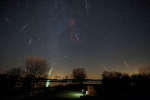
Leonid meteors rained down on planet Earth this week, the annual shower of dusty debris from the orbit of Comet 55P/Tempel-Tuttle. Leonids streak through this composite night skyview from a backyard observatory in southern Ontario.
 A Dangerous Sunrise on Gliese 876d
29.04.2012
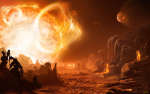
On planet Gliese 876d, sunrises might be dangerous. Although nobody really knows what conditions are like on this close-in planet orbiting variable red dwarf star Gliese 876, the above artistic illustration gives one impression.
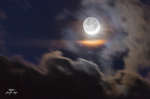 APOD: 2026 April 24 Б Young Moon and Sister Stars
24.04.2026
Sunlit arms of a crescent moon seem to embrace the faint lunar night side in this dramatic celestial scene from planet Earth. The single telephoto exposure tracking the sky was captured on the night of April 19, when a two day old Moon was near perigee in its elliptical orbit.
|
January February March April May June July August September October |
|||||||||||||||||||||||||||||||||||||||||||||||||