
|
You entered: apod
 APOD Turns Eighteen
16.06.2013
The first APOD appeared eighteen years ago today, on 1995 June 16. Although garnering only 14 pageviews on that day, we are proud to estimate that APOD has now served over one billion space-related images over the past eighteen years.
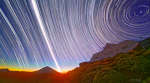 APOD: 2026 March 20 Б Spring Equinox at Teide Observatory
19.03.2026
The defining astronomical moment of the equinox today is at 14:46 UTC (March 20). That's when the Sun crosses the celestial equator moving north in its yearly journey through planet Earth's sky, marking the beginning of spring for our fair planet in the northern hemisphere and fall in the southern hemisphere.
 APOD: 2023 October 24 Б Arp 87: Merging Galaxies from Hubble
23.10.2023
This dance is to the death. As these two large galaxies duel, a cosmic bridge of stars, gas, and dust currently stretches over 75,000 light-years and joins them. The bridge itself is strong evidence that these two immense star systems have passed close to each other and experienced violent tides induced by mutual gravity.
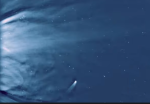 APOD: 2025 March 31 Б Parker: The Solar System from Near the Sun
30.03.2025
If you watch long enough, a comet will appear. Before then, you will see our Solar System from inside the orbit of Mercury as recorded by NASA's Parker Solar Probe looping around the Sun.
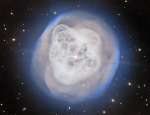 APOD: 2026 May 28 Б NGC 1514: The Crystal Ball Nebula
27.05.2026
What do you see in this crystal ball? The featured image shows NGC 1514, known as the Crystal Ball Nebula, observed by the Gemini North telescope on Maunakea, in Hawai'i. NGC 1514 is 1,500 light-years away and was discovered by William Herschel in 1790.
 APOD: 2024 December 22 Б The Local Fluff
21.12.2024
The stars are not alone. In the disk of our Milky Way Galaxy, about 10 percent of visible matter is in the form of gas called the interstellar medium (ISM). The ISM is not uniform and shows patchiness even near our Sun.
 APOD: 2025 August 22 Б A Tale of Two Nebulae
21.08.2025
This colorful telescopic view towards the musical northern constellation Lyra reveals the faint outer halos and brighter central ring-shaped region of M57, popularly known as the Ring Nebula. To modern astronomers M57 is a well-known planetary nebula.
 APOD: 2025 September 3 Б Cir X1: Jets in the Africa Nebula
2.09.2025
How soon do jets form when a supernova gives birth to a neutron star? The Africa Nebula provides clues. This supernova remnant surrounds Circinus X-1, an X-ray emitting neutron star and the companion star it orbits.
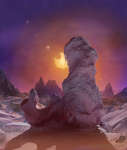 APOD: 2023 February 1 Б The Seventh World of Trappist 1
31.01.2023
Seven worlds orbit the ultracool dwarf star TRAPPIST-1. A mere 40 light-years away, many of the exoplanets were discovered in 2016 using the Transiting Planets and Planetesimals Small Telescope (TRAPPIST) located in the Atlas Mountains of Morocco, and later confirmed with telescope including NASA's Spitzer Space Telescope.
 APOD: 2024 February 20 Б AM1054: Stars Form as Galaxies Collide
19.02.2024
When galaxies collide, how many stars are born? For AM1054-325, featured here in a recently released image by the Hubble Space Telescope, the answer is millions. Instead of stars being destroyed as galaxy AM1054-325 and a nearby galaxy circle each other, their gravity and motion has ignited stellar creation.
|
January February March April May June July August |
||||||||||||||||||||||||||||||||||||||||||||||||||||||||