
|
You entered: gas
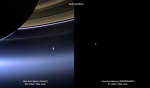 APOD: 2026 June 13 Б Interplanetary Earth
13.06.2026
In an interplanetary first, on July 19, 2013 Earth was photographed on the same day from two other worlds of the Solar System, innermost planet Mercury and ringed gas giant Saturn. Pictured...
 An Immersive Visualization of the Galactic Center
22.01.2018
What if you could look out from the center of our Galaxy -- what might you see? Two scientifically-determined possibilities are shown in the featured video, an immersive 360-degree view which allows you to look around in every direction.
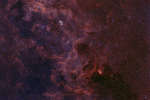 Cosmic Clouds in Cygnus
9.06.2022
These cosmic clouds of gas and dust drift through rich star fields along the plane of our Milky Way Galaxy toward the high flying constellation Cygnus. They're too faint to be seen with the unaided eye though, even on a clear, dark night.
 Journey to the Center of the Galaxy
11.04.2004
In Jules Verne's science fiction classic A Journey to the Center of the Earth, Professor Hardwigg and his fellow explorers encounter many strange and exciting wonders. What wonders lie at the center of our Galaxy?
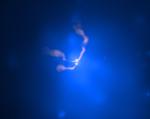 Binary Black Hole in 3C 75
12.04.2006
The two bright sources at the center of this composite x-ray (blue)/ radio (pink) image are co-orbiting supermassive black holes powering the giant radio source 3C 75. Surrounded by multimillion degree x-ray emitting gas, and blasting out jets of relativistic particles the supermassive black holes are separated by 25,000 light-years.
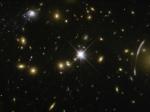 Illusion and Evolution in Galaxy Cluster Abell 2667
5.03.2007
What's happening to the galaxies of cluster Abell 2667? On the upper left, a galaxy appears to be breaking up into small pieces, while on the far right, another galaxy appears to be stretched like taffy.
 M64: The Black Eye Galaxy
20.07.2023
This magnificent spiral galaxy is Messier 64, often called the Black Eye Galaxy or the Sleeping Beauty Galaxy for its dark-lidded appearance in telescopic views. The spiral's central region, about 7,400 light-years across, is pictured in this reprocessed image from the Hubble Space Telescope.
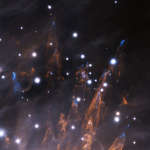 The Orion Bullets
10.01.2013
Cosmic bullets pierce the outskirts of the Orion Nebula some 1500 light-years distant in this sharp infrared close-up. Blasted out by energetic massive star formation the bullets, relatively dense, hot gas clouds about ten times the size of Pluto's orbit, are blue in the false color image.
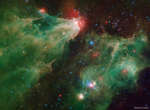 The Cave Nebula in Infrared from Spitzer
11.06.2019
What's happening in and around the Cave Nebula? To help find out, NASA's orbiting Spitzer Space Telescope looked into this optically-dark star-forming region in four colors of infrared light. The Cave Nebula...
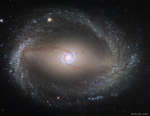 Spiral Galaxy NGC 1512: The Inner Rings
8.05.2022
Most galaxies don't have any rings -- why does this galaxy have two? To begin, the bright band near NGC 1512's center is a nuclear ring, a ring that surrounds the galaxy center and glows brightly with recently formed stars.
|
January February March April May June July August September October |
|||||||||||||||||||||||||||||||||||||||||||||||||