
|
You entered: Milky Way
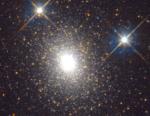 A Giant Globular Cluster in M31
17.10.1998
This cluster of stars, known as G1, is the brightest globular cluster in the whole Local Group of galaxies. Also called Mayall II, it orbits the center of the largest nearby galaxy: M31. G1 contains over 300,000 stars and is almost as old as the entire universe.
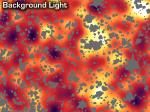 Light from the First Stars
1.01.2007
What were the first stars like? No one is yet sure. Our Sun is not a first-generation star. It is not even second generation. The first stars to appear in the universe likely came and went about 13 billion years ago.
 The Summer Triangle Over Catalonia
10.08.2011
Can you find the Summer Triangle? It's not hard to find this famous triangle of stars this time of year from northern locations. Just look straight up after sunset and find three of the brightest stars in the sky that nearly form a triangle.
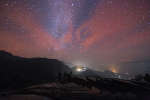 The Terraced Night
6.02.2014
Long after sunset on January 25 an unusually intense red airglow floods this south-looking skyscape. The scene was recorded with a long exposure using a digital camera over Yunnan Province in southwest China. At best faintly visible to the eye, the lingering airglow is due to chemiluminescence, the production of light through chemical excitation.
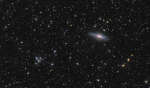 Galaxies in Pegasus
2.12.2016
This wide, sharp telescopic view reveals galaxies scattered beyond the stars of the Milky Way at the northern boundary of the high-flying constellation Pegasus. Prominent at the upper right is NGC 7331. A mere...
 Wolf Lundmark Melotte
18.05.2017
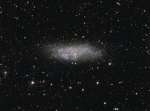
Named for the three astronomers instrumental in its discovery and identification, Wolf - Lundmark - Melotte (WLM) is a lonely dwarf galaxy. Seen toward the mostly southern constellation Cetus, about 3 million light-years from the Milky Way, it is one of the most remote members of our local galaxy group.
 Gemind of the North
16.12.2021
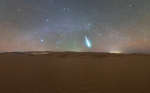
An arid expanse of the Tengger Desert in north-central China, planet Earth fills the foreground of this starry scene. A widefield panoramic view, it was recorded shortly after moonset in the local predawn hours of December 14. Pictured in the still dark sky, stars of the northern winter hexagon surround a luminous Milky Way.
 Giant Emission Nebula NGC 3603 in Infrared
14.08.2002
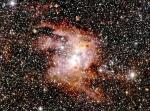
NGC 3603 is the largest region of glowing gas in our Milky Way galaxy. Spanning over 20 light years across, the giant emission nebula (HII region) is home to a massive star cluster, thick dust pillars, and a star about to explode.
 Hale-Bopp Brightest Comet This Decade
12.03.1997
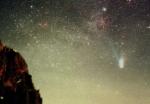
The Great Comet of 1997 is now brighter than the Great Comet of 1996 ever was. In fact, it is brighter than almost every star in the sky. Yet Comet Hale-Bopp is still about two weeks away from maximum light.
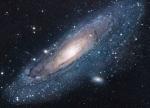 M31: The Andromeda Galaxy
18.07.2004
Andromeda is the nearest major galaxy to our own Milky Way Galaxy. Our Galaxy is thought to look much like Andromeda. Together these two galaxies dominate the Local Group of galaxies. The diffuse light from Andromeda is caused by the hundreds of billions of stars that compose it.
|
January February March April May June July August September October |
|||||||||||||||||||||||||||||||||||||||||||||||||