
|
You entered: atmosphere
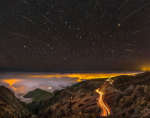 Meteors, Comet, and Big Dipper over La Palma
23.04.2019
Meteor showers are caused by streams of solid particles, dust size and larger, moving as a group through space. In most cases, the orbits of these meteor streams can be identified with dust expelled from a comet.
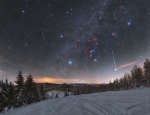 Quadrantid Meteors through Orion
20.01.2020
Why are these meteor trails nearly parallel? Because they were all shed by the same space rock and so can be traced back to the same direction on the sky: the radiant of the Quadrantid Meteor Shower.
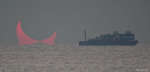 A Distorted Sunrise Eclipse
6.06.2021
Yes, but have you ever seen a sunrise like this? Here, after initial cloudiness, the Sun appeared to rise in two pieces and during partial eclipse, causing the photographer to describe it as the most stunning sunrise of his life.
 APOD: 2023 July 17 Б Shells and Arcs around Star CW Leonis
17.07.2023
What's happening around this star? No one is sure. CW Leonis is the closest carbon star, a star that appears orange because of atmospheric carbon dispersed from interior nuclear fusion. But CW Leonis also appears engulfed in a gaseous carbon-rich nebula.
 APOD: 2024 April 2 Б Detailed View of a Solar Eclipse Corona
2.04.2024
Only in the fleeting darkness of a total solar eclipse is the light of the solar corona easily visible. Normally overwhelmed by the bright solar disk, the expansive corona, the sun's outer atmosphere, is an alluring sight.
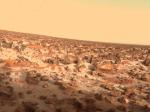 Could Hydrogen Peroxide Life Survive on Mars
28.08.2007
Is there life on Mars? Although no unambiguous evidence for indigenous life on Mars has ever been found, a more speculative question -- could some life forms survive on Mars -- has taken on a new twist.
 The First Rocket Launch from Cape Canaveral
1.10.2008
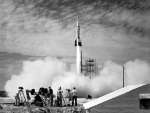
A new chapter in space flight began on 1950 July with the launch of the first rocket from Cape Canaveral, Florida: the Bumper 2. Shown above, the Bumper 2 was an ambitious two-stage rocket program that topped a V-2 missile base with a WAC Corporal rocket.
 A Fading Moonset Over Hong Kong
15.12.2009
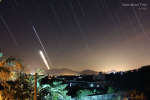
Do stars appear dimmer when nearer the horizon? Yes -- atmospheric air absorbs and reradiates light, so that the greater the airmass through which one peers, the fainter an object will appear. Pictured above in a multi-frame image, stars, the planet Jupiter, and even the Moon show the horizon-dimming effects of Earth's nearly-transparent atmosphere.
 Watch Jupiter Rotate
24.01.2010
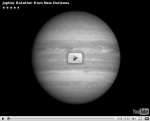
What would it be like to coast by Jupiter and watch it rotate? This was just the experience of the New Horizons spacecraft as it approached and flew by Jupiter in 2007. Clicking on the image will bring up a movie of what the robotic spacecraft saw.
 The Orion Bullets
3.03.2019
Why are bullets of gas shooting out of the Orion Nebula? Nobody is yet sure. First discovered in 1983, each bullet is actually about the size of our Solar System, and moving at about 400 km/sec from a central source dubbed IRc2.
|
January February March April May June July August September October |
|||||||||||||||||||||||||||||||||||||||||||||||||