
|
You entered: night sky
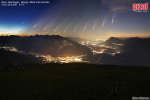 Comet NEOWISE over the Swiss Alps
15.07.2020
Comet NEOWISE has been wowing photographers around much of the world during dawn and dusk, at the margins of day and night. For the most northern residents of planet Earth, however, the comet circles the North Star and never sets.
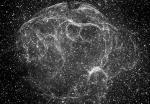 Simeis 147: Supernova Remnant
30.08.2002
It's easy to get lost following the intricate filaments in this stunningly detailed image of faint supernova remnant Simeis 147. Seen towards the constellation Taurus it covers nearly 3 degrees (6 full moons)...
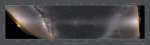 Zodiacal Light Panorama
5.04.2012
Sweeping from the eastern to western horizon, this 360 degree panorama follows the band of zodiacal light along the solar system's ecliptic plane. Dust scattering sunlight produces the faint zodiacal glow that spans...
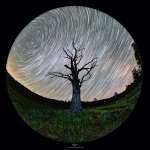 Roots on a Rotating Planet
8.07.2022
With roots on a rotating planet, an old tree is centered in this sequence of 137 exposures each 20 seconds long, recorded one night from northern Sicily. Digital camera and fisheye lens were fixed to a tripod to capture the dramatic timelapse, so the stars trailed through the region's dark sky.
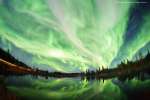 September s Aurora
23.09.2011
September's equinox arrives today at 0905 UT. As the Sun crosses the celestial equator heading south, spring begins in the southern hemisphere and autumn in the north. And though the seasonal connection is still puzzling, both spring and autumn bring an increase in geomagnetic storms.
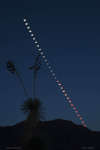 Total Lunar Eclipse at Moonset
19.01.2019
The Moon slid through Earth's shadow on January 31, 2018 in a total lunar eclipse. In this time-lapse sequence of that eclipse from Portal, Arizona, USA, the partial eclipse starts with the Moon high in the western sky.
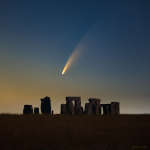 Comet NEOWISE over Stonehenge
14.07.2020
Have you ever seen a comet? Tonight -- and likely the next few nights -- should be a good chance. Go outside just at sunset and look to your northwest. The lower your horizon, the better. Binoculars may help, but if your sky is cloudless and dark, all you should need is your unaided eyes and patience.
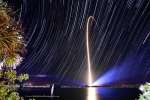 Rocket Streak and Star Trails
30.01.2014
Fixed to a tripod and looking east across the Kennedy Space Center's Turn Basin, a camera captured these star trails as a series of short exposures over a three hour period on the evening of January 23rd.
 APOD: 2024 October 14 Б Comet Tsuchinshan ATLAS Over the Lincoln Memorial
14.10.2024
Go outside at sunset tonight and see a comet! C/2023 A3 (TsuchinshanБATLAS) has become visible in the early evening sky in northern locations to the unaided eye. To see the comet, look west through a sky with a low horizon.
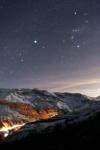 Alborz Mountains in Moonlight
3.02.2007
On January 25th, light from a first quarter Moon illuminated this dreamlike landscape looking across the rugged, snow-covered peaks of the Alborz Mountain Range in northern Iran. The stunning sky is filled with stars, including the yellow-tinged Betelgeuse at the shoulder of Orion.
|
January February March April May June July August September October |
|||||||||||||||||||||||||||||||||||||||||||||||||