
|
You entered: 3D
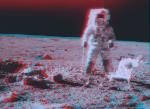 Apollo 12: Stereo View Near Surveyor Crater
21.04.2001
This weekend's stereo picture finds Apollo 12 astronaut Pete Conrad standing on the lunar surface near the southern rim of Surveyor Crater in November of 1969. With red/blue glasses you can gaze beyond the spacesuited Conrad across the magnificent desolation of the Moon's Ocean of Storms.
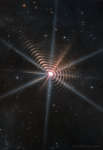 Dust Shells around WR 140 from Webb
13.10.2022
What are those strange rings? Rich in dust, the rings are likely 3D shells -- but how they were created remains a topic of research. Where they were created is well known: in a binary...
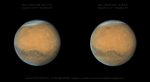 Stereo Mars
3.12.2022
Mars looks sharp in these two rooftop telescope views captured in late November from Singapore, planet Earth. At the time, Mars was about 82 million kilometers from Singapore and approaching its opposition, opposite the Sun in planet Earth's sky on December 8.
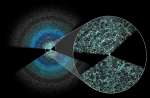 APOD: 2026 April 23 Б Large Scale Structure of the Universe
23.04.2026
This is a map of the universe. The Dark Energy Spectroscopic Instrument (DESI) at Kitt Peak National Observatory, Arizona, has finished its five-year survey. It observed more than 47 million galaxies and quasars and created a 3D map centered on the Earth.
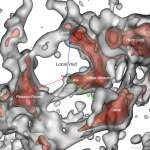 The Local Void in the Nearby Universe
6.08.2019
What does our region of the Universe look like? Since galaxies are so spread out over the sky, and since our Milky Way Galaxy blocks part of the distant sky, it has been hard to tell.
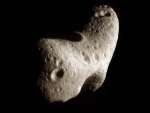 Asteroid Eros Reconstructed
7.06.2009
Orbiting the Sun between Mars and Earth, asteroid 433 Eros was visited by the robot spacecraft NEAR-Shoemaker in 2000 February. High-resolution surface images and measurements made by NEAR's Laser Rangefinder (NLR) have been combined into the above visualization based on the derived 3D model of the tumbling space rock.
 APOD: 2024 May 15 Б AR 3664 at the Suns Edge
15.05.2024
What did the monster active region that created the recent auroras look like when at the Sun's edge? There, AR 3664 better showed its 3D structure. Pictured, a large multi-pronged solar prominence...
 APOD: 2025 January 29 Б Dust Shells around WR 140 from Webb
29.01.2025
What are those strange rings? Rich in dust, the rings are likely 3D shells -- but how they were created remains a topic of research. Where they were created is well known: in a binary...
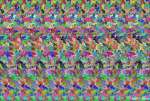 The Holographic Principle and a Teapot
3.10.2021
Sure, you can see the 2D rectangle of colors, but can you see deeper? Counting color patches in the featured image, you might estimate that the most information that this 2D digital image can hold is about 60 (horizontal) x 50(vertical) x 256 (possible colors) = 768,000 bits.
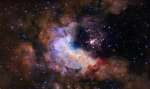 Celestial Fireworks: Into Star Cluster Westerlund 2
4.07.2017
What if you could go right into a cluster where stars are forming? A one-minute, time-lapse, video visualization of just this has been made with 3D computer modeling of the region surrounding the star cluster Westerlund 2, based on images from the Hubble Space Telescope in visible and infrared light.
|
January February March April May June July August September October |
|||||||||||||||||||||||||||||||||||||||||||||||||