
|
You entered: Earth orbit
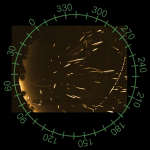 Perseids from Perseus
17.08.2009
Where are all of these meteors coming from? In terms of direction on the sky, the pointed answer is the constellation of Perseus. That is why the last week's meteor shower was known as the Perseids -- the meteors all appear to come from a radiant toward Perseus.
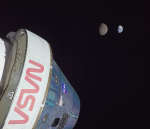 Artemis 1: Flight Day 13
1.12.2022
On flight day 13 (November 28) of the Artemis 1 mission the Orion spacecraft reached its maximum distance from Earth. In fact, over 430,000 kilometers from Earth its distant retrograde orbit also put Orion nearly 70,000 kilometers from the Moon.
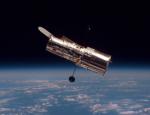 Hubble Floats Free
6.03.1997
Why put observatories in space? Most telescopes are on the ground. On the ground, you can deploy a heavier telescope and upgrade it more easily. The trouble is that Earth-bound telescopes must look through the Earth's atmosphere.
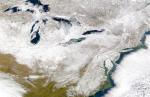 Snowstorm on Planet Earth
31.01.2000
Earth is an ocean planet. From low Earth orbit, the Sea-viewing Wide Field-of-view Sensor (SeaWiFS) instrument onboard NASA's SeaStar spacecraft globally maps ocean color, tracking changes in the climate and biosphere of our water world.
 Leonids from Leo
8.12.1998
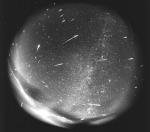
Is Leo leaking? Leo, the famous sky constellation visible on the left of the above all-sky photograph, appears to be the source of all the meteors seen in this year's Leonids Meteor Shower.
 Solar Shock Wave
30.04.1999
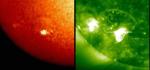
On September 24, 1997 a shock wave blasted across the surface of the sun at speeds of 250 to 600 kilometers per second. On planet Earth, observer Barry Reynolds photographed the expanding shock front (left) in the light emitted by hydrogen atoms at the solar surface.
 Hubble Floats Free
25.05.2009
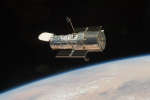
Why put observatories in space? Most telescopes are on the ground. On the ground, you can deploy a heavier telescope and fix it more easily. The trouble is that Earth-bound telescopes must look through the Earth's atmosphere.
 Leonids from Leo
17.11.2002
Is Leo leaking? Leo, the famous sky constellation visible on the left of the above all-sky photograph, appears to be the source of all the meteors seen in last year's Leonids Meteor Shower.
 Chandrayaan 2 Launch
27.07.2019
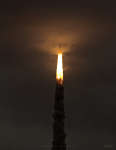
On July 22nd this GSLV (Geosynchronous Satellite Launch Vehicle) MkIII rocket vanished from sight into a cloud bank an instant after this dramatic snapshot was taken. Launched from India's Satish Dhawan Space Centre it carried the Chandrayaan 2 mission spacecraft into Earth orbit.
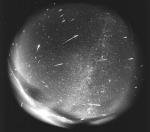 Leonids from Leo
4.11.2001
Is Leo leaking? Leo, the famous sky constellation visible on the left of the above all-sky photograph, appears to be the source of all the meteors seen in 1998's Leonids Meteor Shower. That...
|
January February March April May June July August September October |
|||||||||||||||||||||||||||||||||||||||||||||||||