
|
You entered: Orion Nebula
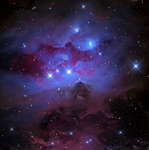 Reflections on the 1970s
18.12.2014
The 1970s are sometimes ignored by astronomers, like this beautiful grouping of reflection nebulae in Orion - NGC 1977, NGC 1975, and NGC 1973 - usually overlooked in favor of the substantial glow from the nearby stellar nursery better known as the Orion Nebula.
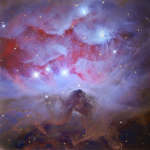 Reflections on the 1970s
13.01.2016
The 1970s are sometimes ignored by astronomers, like this beautiful grouping of reflection nebulae in Orion - NGC 1977, NGC 1975, and NGC 1973 - usually overlooked in favor of the substantial glow from the nearby stellar nursery better known as the Orion Nebula.
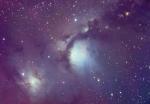 The Reflecting Dust Clouds of Orion
21.01.2003
In the vast Orion Molecular Cloud complex, several bright blue nebula are particularly apparent. Pictured above are two of the most prominent reflection nebulas -- dust clouds lit by the reflecting light of bright-embedded stars. The more famous nebula is M78, on the upper right, cataloged over 200 years ago.
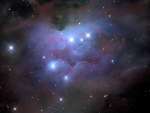 Reflections on the 1970s
20.12.2007
The 1970s are sometimes ignored by astronomers. In particular, this beautiful grouping of reflection nebulae in Orion - NGC 1977, NGC 1975, and NGC 1973 - are usually overlooked in favor of the substantial glow from the nearby stellar nursery better known as the Orion Nebula.
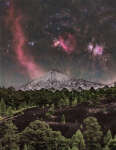 APOD: 2026 May 5 Б Orion over Mount Teide
5.05.2026
Orion is rarely seen like this. To achieve this majestic vista, you need a camera capable of taking such long duration exposures that faint features in the night sky become revealed. Iconic nebulas that appear include the Orion Nebula, the Flame Nebula, and Barnard's Loop.
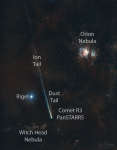 APOD: 2026 May 10 Б Comet R3 PanSTARRS and Orion
10.05.2026
Orion never had a sword like this. As Comet C/2025 R3 (PanSTARRS) heads out of the inner Solar System, it is putting on quite a show for long exposure cameras. Currently seen toward the constellation of Orion the Hunter, the distant Orion Nebula is visible on the upper right.
 APOD: 2024 January 31 Б Camera Orion Rising
31.01.2024
What does Orion rising look like to a camera? During this time of the year, the famous constellation is visible to the southeast just after sunset. From most Earthly locations, Orion's familiar star pattern, highlighted by the three-stars-in-a-row belt stars, rises sideways.
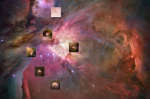 Planetary Systems Now Forming in Orion
22.12.2009
How do planets form? To help find out, the Hubble Space Telescope was tasked to take a detailed look at one of the more interesting of all astronomical nebulae, the Great Nebula in Orion.
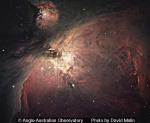 Water From Orion
21.04.1998
Is Orion all wet? Recent observations have confirmed that water molecules now exist in the famous Orion Nebula, and are still forming. The Orion Nebula (M42, shown above) is known to be composed mostly of hydrogen gas, with all other atoms and molecules being comparatively rare.
 The Clouds of Orion the Hunter
15.03.2015
Cradled in cosmic dust and glowing hydrogen, stellar nurseries in Orion the Hunter lie at the edge of giant molecular clouds some 1,500 light-years away. Spanning about 30 degrees, this breath-taking vista stretches across the well-known constellation from head to toe (left to right) and beyond.
|
January February March April May June July August September October |
|||||||||||||||||||||||||||||||||||||||||||||||||