
|
You entered: active galaxy
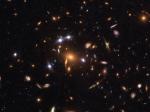 A Five Quasar Gravitational Lens
24.05.2006
What's happening near the center of this cluster of galaxies? At first glance, it appears that several strangely elongated galaxies and fully five bright quasars exist there. In reality, an entire cluster of galaxies is acting as a gigantic gravitational lens that distorts and multiply-images bright objects that occur far in the distance.
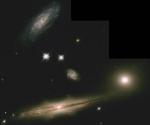 HCG 87: A Small Group of Galaxies
6.09.1999
Sometimes galaxies form groups. For example, our own Milky Way Galaxy is part of the Local Group of Galaxies. Small, compact groups, like Hickson Compact Group 87 (HCG 87) shown above, are interesting partly because they slowly self-destruct.
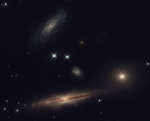 HCG 87: A Small Group of Galaxies
6.07.2010
Sometimes galaxies form groups. For example, our own Milky Way Galaxy is part of the Local Group of Galaxies. Small, compact groups, like Hickson Compact Group 87 (HCG 87) shown above, are interesting partly because they slowly self-destruct.
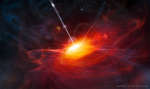 Illustration: An Early Quasar
22.02.2022
What did the first quasars look like? The nearest quasars are now known to involve supermassive black holes in the centers of active galaxies. Gas and dust that falls toward a quasar glows brightly, sometimes outglowing the entire home galaxy.
 X-Ray Wind From NGC 3783
1.06.2000
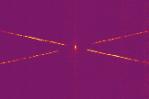
A black hole is supposed to inexorably attract matter. But the intense radiation generated as material swirls and plunges into its high gravity field also heats up surrounding gas and drives it away.
 Messier 77
10.05.2013
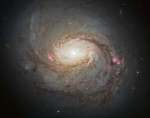
Face-on spiral galaxy M77 lies a mere 47 million light-years away toward the aquatic constellation Cetus. At that estimated distance, the gorgeous island universe is about 100 thousand light-years across. Also known...
 APOD: 2026 August 10 Б Three Galaxy Pairs
10.08.2026
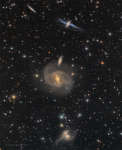
Each of these pairs of galaxies is different. The two galaxies at the top are likely not interacting, at least presently. However, the top galaxy with the blue stripe, NGC 4650A, is a polar ring galaxy and may be the result of a past galaxy collision.
 The Outskirts of M77
7.12.2006
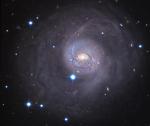
Face-on spiral galaxy M77 lies a mere 60 million light-years away toward the constellation Cetus. Also known as NGC 1068, it's very bright core is well studied by astronomers exploring the mysteries of supermassive black holes in active galaxies.
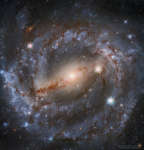 NGC 5643: Nearby Spiral Galaxy from Hubble
5.10.2020
What's happening at the center of spiral galaxy NGC 5643? A swirling disk of stars and gas, NGC 5643's appearance is dominated by blue spiral arms and brown dust, as shown in the featured image taken by the Hubble Space Telescope.
 The X-ray Timing Explorer
3.01.1996
Launched Saturday on a Delta rocket, the X-ray Timing Explorer (XTE) will watch the sky for rapid changes in X-rays. XTE carries three separate X-ray telescopes. The Proportional Counter Array (PCA) and the High Energy X-ray Timing Experiment (HEXTE) will provide the best timing information in the widest X-ray energy range yet available.
|
January February March April May June July August September October |
|||||||||||||||||||||||||||||||||||||||||||||||||