
|
You entered: dark energy
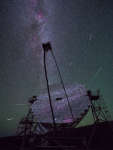 Perseids and MAGIC
11.08.2022
On August 11, 2021 a multi-mirror, 17 meter-diameter MAGIC telescope reflected this starry night sky from the Roque de los Muchachos European Northern Observatory on the Canary Island of La Palma. MAGIC stands for Major Atmospheric Gamma Imaging Cherenkov.
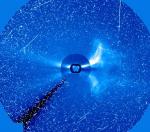 SOHO Composite: Coronal Mass Ejection
20.08.1998
This complex composite image of an ominous and spectacular event - an expanding storm of energetic particles from the Sun - was constructed using data recorded by the SOHO spacecraft on November 6, 1997. Four images...
 AR 2192: Giant on the Sun
24.10.2014
As you (safely!) watched the progress of yesterday's partial solar eclipse, you probably also spotted a giant sunspot group. Captured in this sharp telescopic image from October 22nd the complex AR 2192 is beautiful to see, a sprawling solar active region comparable in size to the diameter of Jupiter.
 Near the Center of the Lagoon Nebula
4.11.2019
Stars are battling gas and dust in the Lagoon Nebula but the photographers are winning. Also known as M8, this photogenic nebula is visible even without binoculars towards the constellation of the Archer (Sagittarius). The energetic processes of star formation create not only the colors but the chaos.
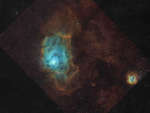 The Lagoon Nebula in Gas, Dust, and Stars
22.07.2009
Stars are battling gas and dust in the Lagoon Nebula but the photographers are winning. Also known as M8, this photogenic nebula is visible even without binoculars towards the constellation of Sagittarius. The energetic processes of star formation create not only the colors but the chaos.
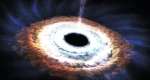 Massive Black Hole Shreds Passing Star
28.10.2015
What happens when a star gets too close to a black hole? Recent observations from Earth-orbiting observatories of an event dubbed ASASSN-14li, in a distant galactic center, appears to be giving one star's harrowing story.
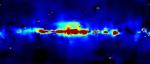 The Milky Way's Gamma-Ray Halo
5.11.1997
Our Milky Way galaxy appears to be surrounded by a halo of gamma rays. Gamma rays are the most energetic form of electromagnetic radiation, with more than a hundred thousand times the energy of visible light, but known gamma-ray sources don't account for the diffuse distribution of this high-energy glow.
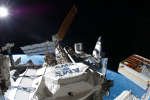 Space Station Detector Finds Unexplained Positron Excess
6.10.2014
Where did all these high energy positrons come from? The Alpha Magnetic Spectrometer (AMS-02) onboard the International Space Station (ISS) has been meticulously recording how often it is struck by both high energy electrons and positrons since 2011.
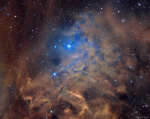 AE Aurigae and the Flaming Star Nebula
25.02.2018
Why is AE Aurigae called the flaming star? For one reason, the surrounding nebula IC 405 is named the Flaming Star Nebula because the region seems to harbor smoke, even though nothing is on fire, including interior star AE Aurigae.
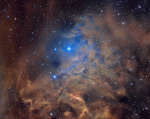 AE Aurigae and the Flaming Star Nebula
7.01.2013
AE Aurigae is called the flaming star. The surrounding nebula IC 405 is named the Flaming Star Nebula and the region seems to harbor smoke, but there is no fire. Fire, typically defined...
|
January February March April May June July August September |
|||||||||||||||||||||||||||||||||||||||||||||||||