
|
You entered: emission nebula
 APOD: 2024 September 10 Б Horsehead and Orion Nebulas
10.09.2024
The dark Horsehead Nebula and the glowing Orion Nebula are contrasting cosmic vistas. Adrift 1,500 light-years away in one of the night sky's most recognizable constellations, they appear in opposite corners of the above stunning mosaic.
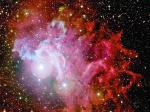 The Flaming Star Nebula from CFHT
28.02.2006
Rippling dust and gas lanes give the Flaming Star Nebula its name. The red and purple colors of the nebula are present in different regions and are created by different processes. The bright star...
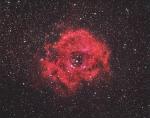 The Rosette Nebula
14.02.1998
Would the Rosette Nebula by any other name look as sweet? The bland New General Catalog designation of NGC 2237 doesn't appear to diminish the appearance of the this flowery emission nebula. Inside the nebula lies an open cluster of bright young stars designated NGC 2244.
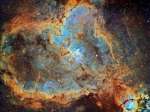 IC 1805: The Heart Nebula
4.03.2013
Sprawling across almost 200 light-years, emission nebula IC 1805 is a mix of glowing interstellar gas and dark dust clouds. Derived from its Valentine's-Day-approved shape, its nickname is the Heart Nebula. About 7,500 light-years away in the Perseus spiral arm of our galaxy, stars were born in IC 1805.
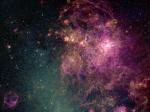 30 Doradus: The Tarantula Zone
12.12.2005
The Tarantula Nebula is more than 1,000 light-years across - a giant emission nebula within our neighboring galaxy the Large Magellanic Cloud. Inside this cosmic arachnid lies a central young cluster of massivestars, cataloged as R136, whose intense radiation and strong winds have helped energize the nebular glow and shape the spidery filaments.
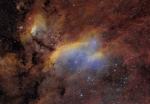 IC 4628: The Prawn Nebula
20.10.2006
South of Antares, in the tail of the nebula-rich constellation Scorpius, lies emission nebula IC 4628. Nearby hot, massive stars, millions of years young, radiate the nebula with invisible ultraviolet light, stripping electrons from atoms. The electrons eventually recombine with the atoms to produce the visible nebular glow.
 APOD: 2023 July 26 Б IC 4628: The Prawn Nebula
26.07.2023
South of Antares, in the tail of the nebula-rich constellation Scorpius, lies emission nebula IC 4628. Nearby hot, massive stars, millions of years young, irradiate the nebula with invisible ultraviolet light, stripping electrons from atoms. The electrons eventually recombine with the atoms to produce the visible nebular glow, dominated by the red emission of hydrogen.
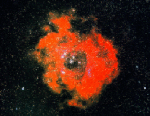 NGC 2237: The Rosette Nebula
14.02.1996
Would the Rosette nebula by any other name look as sweet? The bland New General Catalog designation of NGC 2237 doesn't appear to diminish the appearance of the this flowery emission nebula. Inside the nebula lies an open cluster of bright young stars designated NGC 2244.
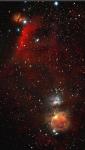 Orion Nebulosities
30.05.2002
Adrift 1,500 light-years away in one of the night sky's most recognizable constellations, the glowing Orion Nebula and the dark Horsehead Nebula are contrasting cosmic vistas. They both appear in this stunning composite color photograph along with other nebulosities as part of the giant Orion Molecular Cloud complex, itself hundreds of light-years across.
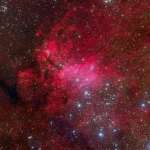 IC 4628: The Prawn Nebula
7.09.2012
South of Antares, in the tail of the nebula-rich constellation Scorpius, lies emission nebula IC 4628. Nearby hot, massive stars, millions of years young, radiate the nebula with invisible ultraviolet light, stripping electrons from atoms. The electrons eventually recombine with the atoms to produce the visible nebular glow, dominated by the red emission of hydrogen.
|
January February March April May June July August September October |
|||||||||||||||||||||||||||||||||||||||||||||||||