
|
You entered: Ring Nebula
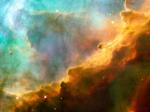 APOD: 2004 August 28- M17: A Hubble Close-Up
28.08.2004
Sculpted by stellar winds and radiation, these fantastic, undulating shapes lie within the stellar nursery known as M17, the Omega Nebula, some 5,500 light-years away in the nebula-rich constellation Sagittarius. The lumpy features...
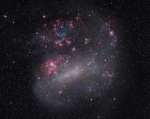 Hydrogen in the LMC
26.04.2011
A satellite galaxy of our own Milky Way, the Large Magellanic Cloud (LMC) is an alluring sight in dark southern skies and the constellation Dorado. A mere 180,000 light-years distant...
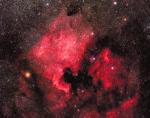 The North America Nebula
1.05.2000
Here's a familiar shape in an unfamiliar location! This emission nebula is famous partly because it resembles Earth's continent of North America. To the right of the North America Nebula, cataloged as NGC 7000, is a less luminous Pelican Nebula.
 Pleiades to Hyades
17.11.2011
This cosmic vista stretches almost 20 degrees across the gentle constellation Taurus. It begins at the Pleiades and ends at the Hyades, two of the best known star clusters in planet Earth's sky. At left, the lovely Pleiades star cluster is about 400 light-years away.
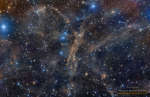 A Dust Angel Nebula
28.04.2016
The combined light of stars along the Milky Way are reflected by these cosmic dust clouds that soar some 300 light-years or so above the plane of our galaxy. Dubbed the Angel Nebula, the faint apparition is part of an expansive complex of dim and relatively unexplored, diffuse molecular clouds.
 APOD: 2025 November 19 Б Chamaeleon Dark Nebulas
19.11.2025
Sometimes the dark dust of interstellar space has an angular elegance. Such is the case toward the far-south constellation of Chamaeleon. Normally too faint to see, dark dust is best known for blocking visible light from stars and galaxies behind it.
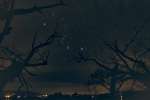 The Hunter s Stars
19.01.2012
Begirt with many a blazing star, Orion, the Hunter, is one of the most easily recognizable constellations. In this night skyscape from January 15, the hunter's stars rise in the northern hemisphere...
 APOD: 2024 February 27 Б Supernova Remnant Simeis 147
27.02.2024
It's easy to get lost following the intricate, looping, and twisting filaments of supernova remnant Simeis 147. Also cataloged as Sharpless 2-240, the filamentary nebula goes by the popular nickname the Spaghetti Nebula.
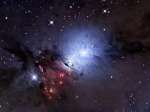 NGC 1333 Stardust
18.04.2009
NGC 1333 is seen in visible light as a reflection nebula, dominated by bluish hues characteristic of starlight reflected by dust. A mere 1,000 light-years distant toward the heroic constellation Perseus, it lies at the edge of a large, star-forming molecular cloud.
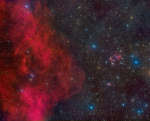 Barnard Stares at NGC 2170
19.01.2013
A gaze across a cosmic skyscape, this telescopic mosaic reveals the continuous beauty of things that are. The evocative scene spans some 6 degrees or 12 Full Moons in planet Earth's sky. At the left, folds of red, glowing gas are a small part of an immense, 300 light-year wide arc.
|
January February March April May June July August September October |
|||||||||||||||||||||||||||||||||||||||||||||||||