
|
You entered: young stars
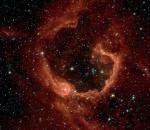 RCW 79: Stars in a Bubble
15.04.2005
A cosmic bubble of gas and dust, RCW 79 has grown to about 70 light-years in diameter, blown by the winds and radiation from hot young stars. Infrared light from the dust embedded in the nebula is tinted red in this gorgeous false-color view from the Spitzer Space Telescope.
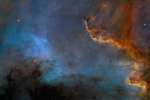 Along the Cygnus Wall
3.07.2014
The prominent ridge of emission featured in this vivid skyscape is known as the Cygnus Wall. Part of a larger emission nebula with a distinctive shape popularly called The North America Nebula, the ridge spans about 10 light-years along an outline that suggests the western coast of Mexico.
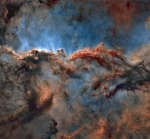 APOD: 2024 June 19 Б NGC 6188: Dragons of Ara
19.06.2024
Do dragons fight on the altar of the sky? Although it might appear that way, these dragons are illusions made of thin gas and dust. The emission nebula NGC 6188, home to the glowing...
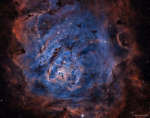 The Lagoon Nebula in Hydrogen Sulfur and Oxygen
5.01.2016
The majestic Lagoon Nebula is filled with hot gas and the home for many young stars. Spanning 100 light years across while lying only about 5000 light years distant, the Lagoon Nebula is so big and bright that it can be seen without a telescope toward the constellation of the Archer (Sagittarius).
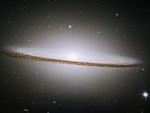 The Sombrero Galaxy from HST
8.10.2003
Why does the Sombrero Galaxy look like a hat? Reasons include the Sombrero's unusually large and extended central bulge of stars, and dark prominent dust lanes that appear in a disk that we see nearly edge-on. Billions of old stars cause the diffuse glow of the extended central bulge.
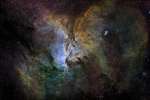 Shaping NGC 6188
2.05.2008
Dark shapes with bright edges winging their way through dusty NGC 6188 are tens of light-years long. The emission nebula is found near the edge of an otherwise dark large molecular cloud in the southern constellation Ara, about 4,000 light-years away.
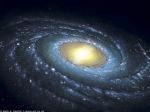 Milky Way Illustrated
4.01.2005
What does our Milky Way Galaxy look like from afar? Since we are stuck inside, and since opaque dust truncates our view in visible light, nobody knows for sure. Drawn above, however, is a good guess based on many different types of observations.
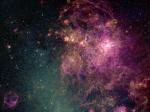 30 Doradus: The Tarantula Zone
12.12.2005
The Tarantula Nebula is more than 1,000 light-years across - a giant emission nebula within our neighboring galaxy the Large Magellanic Cloud. Inside this cosmic arachnid lies a central young cluster of massivestars, cataloged as R136, whose intense radiation and strong winds have helped energize the nebular glow and shape the spidery filaments.
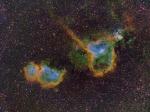 The Heart and Soul Nebulas
10.08.2005
Is the heart and soul of our Galaxy located in Cassiopeia? Possibly not, but that is where two bright emission nebulas nicknamed Heart and Soul can be found. The Heart Nebula, officially dubbed IC 1805 and visible above on the right, has a shape reminiscent of a classical heart symbol.
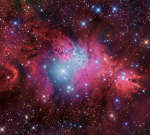 Fox Fur, Unicorn, and Christmas Tree
7.02.2019
Clouds of glowing hydrogen gas fill this colorful skyscape in the faint but fanciful constellation Monoceros, the Unicorn. A star forming region cataloged as NGC 2264, the complex jumble of cosmic gas and dust...
|
January February March April May June July August September October |
|||||||||||||||||||||||||||||||||||||||||||||||||