
|
You entered: Milky Way
 Once Upon a Solstice Eve
23.12.2016
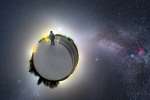
Once upon a solstice eve a little prince gazed across a frozen little planet at the edge of a large galaxy. The little planet was planet Earth of course, seen in this horizon to horizon, nadir to zenith projection, a digitally stitched mosaic from the shores of the Sec reservoir in the Czech Republic.
 55 Nights with Saturn
29.09.2018
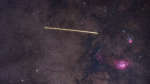
For 55 consecutive nights Mediterranean skies were at least partly clear this summer, from the 1st of July to the 24th of August 2018. An exposure from each night was incorporated in this composited telephoto and telescopic image to follow bright planet Saturn as it wandered through the generous evening skies.
 A Flow of Time
9.04.2020
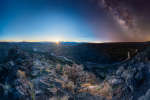
This surreal timelapse, landscape, panorama spans predawn, blue hour, and sunrise skies. Close to the start of planet Earth's northern hemisphere spring, the flow of time was captured between 4:30 and 7:00 am from a location overlooking northern New Mexico's Rio Grande Valley.
 Winter and Summer on a Little Planet
30.11.2024
Winter and summer appear to come on a single night to this stunning little planet. It's planet Earth of course. The digitally mapped, nadir centered panorama covers 360x180 degrees and is composed of frames recorded during January and July from the Col du Galibier in the French Alps.
 APOD: 2026 July 6 Б Dueling Bands over the Atacama Desert
6.07.2026
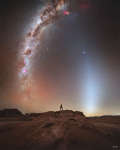
What are these two bands in the sky? The more commonly seen band is on the left and is the central band of our Milky Way galaxy. Our Sun orbits in the disk of this spiral galaxy so that from inside, it appears as a band of comparable brightness all the way around the sky.
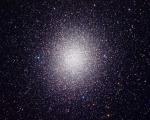 Millions of Stars in Omega Centauri
16.04.2002
Pictured above is the largest ball of stars in our Galaxy. About 10 million stars orbit the center of this globular cluster - named Omega Centauri - as this giant globular cluster orbits our Galactic center.
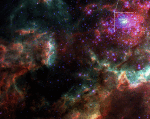 In the Center of 30 Doradus
24.05.1996
In the center of 30 Doradus lies a huge cluster of the largest, hottest, most massive stars known. The center of this cluster, known as R136, is boxed in the upper right portion of the above picture.
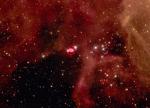 A Supernova Starfield
9.02.1999
Bright stars don't last forever. A bright star similar to others in this field exploded in a spectacular supernova that was witnessed on Earth in 1987. The result is visible even today as unusual rings and glowing gas. The above picture is a composite of recent images taken over several years.
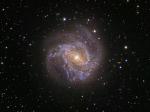 Spiral Galaxy M83: The Southern Pinwheel
24.07.2007
M83 is one of the closest and brightest spiral galaxies on the sky. Visible with binoculars in the constellation of Hydra, majestic spiral arms have prompted its nickname as the Southern Pinwheel. Although discovered...
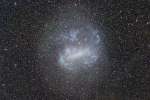 A Large Magellanic Cloud Deep Field
9.04.2008
Is this a spiral galaxy? No. Actually, it is the Large Magellanic Cloud (LMC), the largest satellite galaxy of our own Milky Way Galaxy. The LMC is classified as a dwarf irregular galaxy because of its normally chaotic appearance. In this deep and wide exposure, however, the full extent of the LMC becomes visible.
|
January February March April May June July August September October |
|||||||||||||||||||||||||||||||||||||||||||||||||